
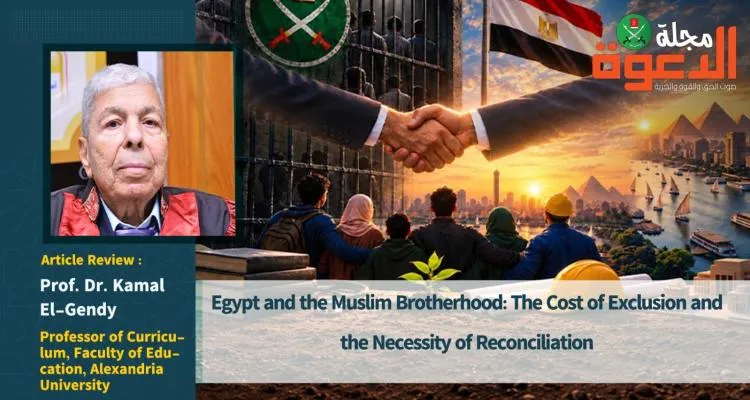
Egypt and the Muslim Brotherhood: The Cost of Exclusion and the Necessity of Reconciliation
On his Facebook page, Prof. Dr. Kamal El-Gendy published an article well worth reading. It offers the perspective of an independent academic and patriotic figure. We have chosen to share it with our readers to enrich the discussion of this significant national issue. The source link is provided at the end of the article.
Presented by: Al-Da’wah Magazine
The article, titled "Egypt and the Muslim Brotherhood: The Cost of Exclusion and the Necessity of Reconciliation," examines the consequences of excluding the Muslim Brotherhood from public life in Egypt. It links persistent political polarisation to diminishing prospects for national consensus and social stability.
The author argues that the crisis goes beyond a mere dispute between the authorities and a single political faction; rather, it marks the closing of the public sphere and the squandering of human and professional potential that Egyptian society desperately needs.
The author contends that such conflicts cannot be resolved through collective punishment or the criminalisation of intellectual and political affiliations. Instead, resolving them requires creating space for dialogue and participation within the framework of the rule of law.
Exclusion and the Erosion of the Political Sphere
The article argues that relying solely on a security-based approach to the Muslim Brotherhood fails to address the root causes of the crisis; instead, it merely defers resolution while deepening the crisis's negative impact.
According to the author, the exclusion of a movement with a significant social and political presence weakens pluralism, diminishes the possibility of an organised opposition, and makes the construction of a comprehensive national consensus far more difficult. It is also argued that excluding segments of the citizenry from public participation widens the gap between them and state institutions, thereby hindering society’s ability to overcome its state of division.
Media and the Construction of an "Adversary" Image
The article examines the role of the media and political discourse in shaping attitudes towards the Muslim Brotherhood following the January 2011 revolution and the events that followed.
The author suggests that genuine concerns held by certain segments of the Egyptian population were exploited through a discourse that cast the group as an all-encompassing threat. This discourse conflated criticism of the group’s political and organisational performance with rejection of its social presence and of its members’ right to participate in public life.
The article emphasises that rejecting hatred does not require agreeing with the group’s ideology or overlooking its past errors. Rather, it calls for reliance on dialogue and individual accountability, rather than holding an entire group responsible for the actions of specific individuals or for contested political stances.
Who Benefits from the Division?
The author examines the regional and international dimensions of the Egyptian crisis, arguing that the persistent internal division serves the interests of Israel and certain American policy-making circles. This division weakens Egypt’s capacity to forge a coherent national position and to fulfil its role in the region.
The author observes a contradiction in U.S. policy: a gap between its stated rhetoric on democracy and human rights and its actual security and strategic priorities in the region. Furthermore, he argues that Egypt’s preoccupation with its internal conflicts diminishes its ability to influence Arab affairs—most notably the Palestinian cause.
As presented in the article, this perspective serves as an analytical thesis about the interests and roles of external actors; assigning specific responsibility to each party for the unfolding of the Egyptian crisis would require further, detailed evidence.
Social and Economic Impacts
The article examines what it terms the "social cost" of exclusion, highlighting the erosion of social bonds, the shrinking space for civic and trade-union activity, and the spread of fear and distrust.
It also highlights the issue of "wasted potential"—referring to individuals such as prisoners, migrants, and experienced professionals who are sidelined from public life—and argues that enabling them to contribute to professional and civic spheres would benefit both development and society as a whole.
Economically, the author links persistent political tension to a lack of confidence in the stability of the legal framework. He asserts that the rule of law and clear, transparent rules for participation are essential to fostering a more stable environment for business and investment.
Furthermore, the author warns that continued repression and the closure of avenues for peaceful political engagement may fuel despair and resentment among some young people. This serves as a cautionary note about potential risks; it does not imply that exclusion inevitably leads to radicalisation or violence.
Reconciliation and Individual Responsibility
The article advocates a national reconciliation process that would enable Egyptians—regardless of their diverse viewpoints—to live and participate in society on the basis of citizenship and equality before the law.
Prof. Dr. Kamal El-Gendy
Professor of Curriculum, Faculty of Education, Alexandria University