

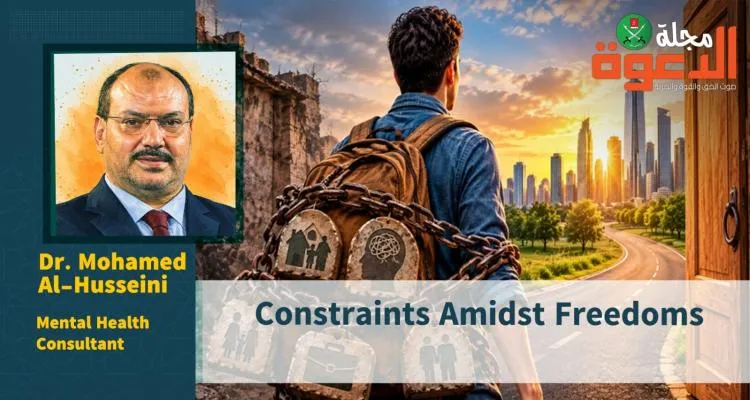
Constraints Amidst Freedoms
We may leave our homes and move to countries that offer greater opportunities for work and education, yet we continue to live with the very same ideas and fears we brought with us. While our physical surroundings change, internal boundaries—which we have never attempted to transcend—remain, and we may even pass them on to our children without realising it.
Some of these boundaries are forged by difficult experiences, while others are inherited from our environment and upbringing. They may once have had their reasons, but circumstances change; what was once impossible in one place may become entirely feasible elsewhere. The problem arises when we judge a new opportunity through the lens of an old experience, effectively closing a door before we even know what lies beyond it.
I once met a young man in his twenties who had moved with his family to a new country. He complained about his father’s controlling nature and his desire to mould him into a carbon copy of himself. The young man wanted to launch an independent venture, but he was terrified of straying from the path his father had mapped out for him.
When he finally took the leap and pursued his own path, he established a company, earned a steady income, and eventually diversified his revenue streams. His success had a positive impact on his father, who began to praise him and take pride in his achievements—a stark contrast to the apprehension he had initially felt about his son’s choices.
I cannot say what might have happened had his first attempt failed, but his success revealed to both him and his father that the path they were accustomed to was not the only one. This is something we must keep in mind when offering advice to our children; we might inadvertently block them from a fitting opportunity simply because we are unfamiliar with it, or because we fear for them based on experiences we have never had.
On the other hand, I once knew a man with experience who had spent his entire career working within various institutions and corporations. I once spoke with him about leveraging his expertise for a personal venture—an additional pursuit to prepare him for life after his formal employment. He, however, felt entirely secure in his position, convinced that his employers would never let him go.
As time passed, he reached retirement age, and organisations no longer sought his services. He suddenly found himself in need of alternatives—options he could have begun developing years earlier.
His choice of a career was not the mistake; rather, it was his assumption that it would last forever, without any preparation for what might follow. While a job can provide a decent life and a sense of accomplishment—and private enterprise carries the risk of both success and failure—pinning one’s entire future on a single entity leaves a person in a precarious position should that entity’s circumstances, or its need for that individual, change.
This is why I believe it is essential to periodically re-evaluate our choices. What have we learned over our working years? What can we offer beyond the confines of our current roles? Could we perhaps start with something small—a low-stakes experiment that does not place an undue burden on ourselves or our families?
Not everyone who hesitates is incapable; some may have responsibilities that prevent them from risking their primary source of income. Conversely, not everyone who takes the initiative is necessarily prepared for success. Yet fear alone should not be the deciding factor. We ought to seek counsel from those with experience, acquire the skills we lack, assess what we can realistically manage, and then—give it a try. Even a modest first attempt can reveal insights that remain hidden when we simply stand still.
The same process of re-evaluation is necessary when raising children. We wish them well, but we may sometimes conflate their true best interests with our desire for them to become like us. We share our experience with them, discuss their choices, and give them space to experiment and take responsibility—all while remaining by their side whenever they need us.
Maintaining a positive expectation of God (husn al-zann) empowers us to strive and overcome fear; yet it does not absolve us of the need to learn and plan. Sometimes, despite our best efforts, we may fall short of our goals—in such cases, we reflect on the experience and try again. Stumbling is painful, but it does not render every attempt a failure; likewise, the success of one endeavour does not guarantee the same outcome for everyone who follows the same path.
While we cannot change every circumstance, we can ask ourselves honestly: does this constraint still truly exist, or have we simply grown so accustomed to it that we no longer even try to break free?
Perhaps the door has been open all along, and we have simply never approached it.
*Disclaimer:* The articles only express the views of their authors and do not necessarily reflect the opinion of the magazine or the Brotherhood.