Seminar on: Designation of Islamic Social Movements as ‘Terrorist Entities’.. Risks and Repercussions
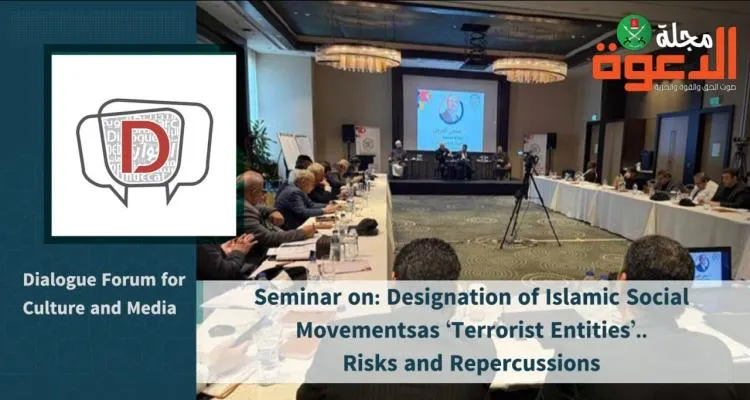
On 14 January 2026, the Istanbul-based Dialogue Forum for Culture and Media (DFCM) held an extensive symposium titled: "Designation of Islamic Social Movements as ‘Terrorist Entities’: Risks and Repercussions", dedicated to discussion of the American decision to designate certain components of the Muslim Brotherhood ‘as terrorist’, and to anticipation of its political, legal, and societal implications for the Islamic world and Muslims in the West. The seminar was inaugurated by DFCM Director Mr. Khaled Ashour. It comprised thirteen diverse presentations spread across three sessions, in addition to a closing session for recommendations. Dr. Hamza Zawba, the Egyptian media figure, chaired the first session, opening it by emphasizing the significance of the "timing of the seminar", which came in the wake of two decisions made by the White House: one from the Treasury Department and the other from the State Department. He argued that any discussion of the American decisions must proceed from the "broader picture or context" built upon "the relationship with Islam in a clear and explicit manner", as Islam had become "the primary political target — the first arrow aimed at Islam by any electoral candidate in Europe or the United States", before general "Islamophobia" evolved into a narrower circle, which he termed "Ikhwanophobia".
Dr. Essam al-Bashir: Brotherhood Centrism and the Currents of Contemporary Thought:
His Eminence Sheikh Dr. Essam al-Bashir presented the first paper, titled "The Impact of the Brotherhood's Centrist Islamic Thought on the Nation and Islamic Communities", explaining that the meaning of "the middle" in Arabic indicates and revolves around "justice", "goodness", and "the praiseworthy balance between the extremes of excess and negligence", citing Quranic verses including: ﴾ The most moderate of them said, "Did I not say to you, 'Why do you not exalt [Allah]?' ﴿ (Al-Qalam: 28) and: ﴾ And thus we have made you a just community that you will be witnesses over the people and the Messenger will be a witness over you…﴿ (Al-Baqarah: 143) and:﴾ And the heaven He raised and imposed the balance. That you do not transgress within the balance. And establish weight in justice and do not make deficient the balance. ﴿ (Al-Rahman: 7-9)
Dr. Al-Bashir introduced a comprehensive definition of the ‘centrism’ adopted by the Muslim Brotherhood as: presentation of Islam as "a guiding methodology for time, place, and mankind, connected to reality, explained in the modern-day language, combining sound transmitted knowledge with clear reason … conservative in its aims and ends, progressive in its means and mechanisms, firm in its foundations and universals, flexible in its branches and particulars, facilitative in expression of religious opinion, ‘proselytizing’ with respect to Islamic Message, open to civilizations without dissolution, and mindful of particularity without insularity."
Al-Bashir showed that Muslim Brotherhood Founder Imam Hassan al-Banna entrenched this centrist method through the element of "understanding" and its ten principles (Message of Teachings): at the level of creed through "the broad conception of the Ahl al-Sunnah wal-Jamaʻa [Muslims who follow the very same way which Prophet Muhammad (peace and blessings be upon him) and his Companions (may Allah be pleased with them all) followed]; at the jurisprudential level, between "the rigidity of the legal schools" and "leaping over reality", calling for acceptance of the ‘Madhhabs” (schools of Islamic jurisprudence) "in general without fanaticism toward any specific one" and recognition of the scholarly accumulation of the nation. Sheikh Al-Bashir also addressed the centrist education, situated between "the eccentricities that some Sufis fell into" and "the rigidity that some affiliated with Salafism fell into", through adoption of a "Sufi reality" based on the purification of the soul and the refinement of the spirit without excesses, along with restricting excommunication to denying what is necessarily known of the religion, or the explicit denial of the Quran, or its interpretation in ways the language cannot bear.
Al-Bashir then moved to the impact of this edifice in deconstructing five intellectual currents in contemporary reality: the "suicidal tendency" which "began with excommunication and ended with explosion"; the "dazzled thinking" captivated by Western civilization; the "conditional/confrontational thinking" that converts probabilities into certainties; the "regurgitative thought" that lives in a vessel of the past; against the "moderate current" that spreads the meanings of centrism as a project of renaissance transferring the nation "from the world of existence to the world of witness." He also presented seven pillars for the relationship of centrist thought to the other, including "belief in the unity of human origin", "dignity for all children of mankind", "human brotherhood", "difference by Allah's will", "mutual acquaintance", "argumentation in the best manner", and "the law of righteousness and justice", pausing to consider the contribution of jurisprudential references in the West to transcending the division of the world into "the abode of war" and "the abode of Islam" in favour of viewing it as an "abode of covenant" and "abode of preaching", where the Muslim is committed to respecting the law and constitution in exchange for the preservation of his doctrinal belonging.
Dr. Saif Eddin Abdel Fattah: Defining the Brotherhood as a Social Movement and the Crisis of Concepts:
Professor of Political Science Saif Eddin Abdel Fattah emphasized in his paper "Defining the Muslim Brotherhood as a Social Movement", the significance of beginning with description before classification, arguing that "political Islam is a heresy manufactured in Western laboratories and then attacked by them", because "Islam for us is indivisible and does not become absorbed in any single domain." He rejected the reduction of Islam into categories such as "political Islam, economic Islam, Turkish Islam, or Asian Islam", affirming that these divisions serve a Western perspective seeking to control the religious sphere.
He clarified that the Brotherhood is "not a political party" nor "merely an association, charitable body, or civil society institution", but a broader social movement of which "the political party can be one of its manifestations", alongside a network of organizations operating in various fields, and that "the word organization" is not an accusation in itself but one of the movement's manifestations in its social dimension. He dwelt on the relationship between "the nation, the state, authority, and society", arguing that "society is the product of our virtues and authority is the product of our implications ", and that the balance between them is the essence of the Islamic vision, while "the Arab authoritarian state" looks with "exclusionary eyes at all active societal forces" and sees societal effectiveness as "coming at the expense of state power", making "every social force – including the Brotherhood – a target for exclusion".
Abdel Fattah addressed the crisis of defining the concepts of "aggression" and "terrorism" in the international system, recalling the failure of the United Nations General Assembly to agree on a definition of aggression, and the exploitation by major powers of this gap to label their own defensive actions and those of their adversaries as terrorism, citing Noam Chomsky's critique of the United States as "the world's first rogue state". He linked "the international system of despotism" and "internal despotic systems" in their use of the terrorism charge "as both stick and carrot", arguing that "terrorism has become a new Western code" managed through "Islamophobia or Ikhwanophobia" and used by Arab regimes to curry favor with the West by proclaiming their fight against "the terrorism we are fighting".
Dr. Mohamed al-Mukhtar al-Shinqiti: The Intellectual Context and the Manufacturing of the Enemy:
Dr. Mohamed al-Mukhtar al-Shinqiti's presentation came in the context of the Western fabrication of the term "political Islam" to frame all movements that seek to engage with public affairs – particularly in the Arab–Zionist conflict and resistance to global injustice. He indicated that the classification of Islamic movements – particularly the Muslim Brotherhood – is not a response to new security realities so much as a link in a long chain of "manufacturing the Islamic enemy" that began with the end of the Cold War and deepened after 11 September (9/11), under the direct influence of Zionist lobbies and certain Arab regimes. He argued that the most dangerous aspect of these designations is that they reproduce the climate that criminalizes peaceful political participation, and close democratic pathways before movements with deep social roots – threatening global stability and undermining the prospects for peaceful reform in the Arab and Islamic world.
Al-Shinqiti showed that this intellectual shift opened the door to linking Islamic movements – including the Muslim Brotherhood – with the concept of "terrorism" in Western consciousness, even though they are at their core social and political movements seeking peaceful participation. This makes their classification a continuation of a long process of "manufacturing the enemy" more than a response to specific acts of material violence.
Al-Shinqiti dwelt on the contradiction within the American constitutional framework: the First Amendment permits any citizen to believe in the ideas of the Brotherhood or Hamas, and even to declare membership, "so long as they do not commit" an act contrary to law. Yet following the 2010 amendment, the judiciary ruled that even offering "advice" to a classified movement – such as Hamas – constitutes a form of punishable "material support" carrying a prison sentence, even if the advice was to renounce violence and recognize the enemy. He also clarified that the Treasury Department, unlike the State Department, does not afford the affected party an effective right to litigation, making its designation an ideal tool for "name-smearing" without needing to convince a judge that the legal elements of terrorism in the precise technical sense are present.
He argued that the essence of the most recent decision is "name-smearing", because "most people will not distinguish between the Treasury and the State Department" and will take the media headline at face value, while those designated under Treasury are denied the right to direct legal challenge, unlike a State Department designation which – theoretically – allows recourse to the courts within 30 days. He warned that this sends a troubling message to the effect that belonging to a peaceful political movement can be treated as evidence of "terrorist potential", and that "fleeing from this issue is not the solution" – what is required is to confront it with a deep understanding of its legal, media, legislative, and executive dimensions.
Dr. Helmi al-Jazzar: A Reformist Experience, Not an Organization of Violence:
Dr. Helmi al-Jazzar offered a reading from within the parliamentary and trade union experience, affirming that speaking about the Muslim Brotherhood "is not only about an organization, but about an extended historical experience and a school of public work that has traversed multiple paths: ‘dawah’ (Islamic call), social, political, trade union, and parliamentary." He clarified that "since its founding, the Brotherhood has not been a movement of violence, but a movement of reform", while acknowledging the existence of errors and mistaken judgements, though "the general method has always been peaceful reform, gradualism, and working from within society".
Al-Jazzar stressed the need to distinguish between "errors of individuals or errors of political judgment" and the "overall method" of the movement, reviewing their experience in parliament where they worked "within the ceiling of the law", participated in elections, and adhered to the rules of the political game despite "security restriction, fraud, and media siege." He argued that the very moment the political space opened following the January revolution (2011) proved that "the current that adhered to non-violence was the one that earned the people's trust through ballot boxes, not through arms or militias." Yet the democratic experiment was aborted due to the refusal of the deep state, the region, and the international order to accept election results that did not suit their inclinations.
He argued that the talk about the designation of the Muslim Brotherhood (as terrorist) "cannot be separated from fear of democracy itself", since democracy that produces unwanted forces is confronted by delegitimizing those forces through the label of terrorism or anti-democracy. He warned that the message of the designation decision is that: "there is no use in peaceful action and no use in democratic participation", which may push some young people toward despair at politics. He also argued that defending the right of the Brotherhood, or any peaceful movement, to work openly is a defense of stability and social peace, not of any specific organization.
Dr. Sami al-Arian: Political Backgrounds and Pressure Lobbies:
The second session was chaired by Dr. Saif Eddin Abdel Fattah. Dr. Sami al-Arian opened with his remarks on the course of lobbies and the struggle over the definition of "political Islam", reviewing how American attention before 1990 was focused on "the Soviet danger or the communist danger", and how the view of Islamic movements was less hostile – they were even used in confronting the communist tide, as happened in Afghanistan. He dated the beginnings of "manufacturing the Islamic enemy" to the first Palestinian Intifada, when "the Mossad sent some agents to penetrate the American political system", with the first penetration occurring in 1989 through Yossef Bodansky, who established the "Task Force on Terrorism and Unconventional Warfare" within Congress, in parallel with academic studies – such as those of Bernard Lewis and then Samuel Huntington – that sought to establish the idea that "Islamic movements are the enemy of the future."
Al-Arian noted that the events of 11 September 2001 transformed this course into "public policy", and that the American empire "always needs an enemy" to justify defense and security budgets, in the context of unipolarity following the collapse of the Soviet Union, while the Islamic Revolution in Iran played the role of a "parallel track" concerning Shiʻa political Islam. He presented a framework with three questions – "why, how, what" – explaining that "why" is linked to the "grand strategy" of building a regional bloc against political Islam, reshaping the space of political action for Muslims in America, and rebalancing public opinion following the war of extermination in Gaza and the Al-Aqsa Flood, against a backdrop of Arab regimes that "see a genuine threat to their future" regardless of the name of the Islamic movements.
On the "how" axis, he explained the legislative, executive, and public relations strategies: continuous attempts since the nineties to pass laws against sharia or Islamic movements, and the use of executive orders when legislation proved difficult, alongside a vast network of think tanks and media outlets funded with hundreds of millions of dollars to fix the mental association between "Islam" and "terrorism." Turning to "what", he detailed the differences between State Department designation (as a foreign terrorist organization) and Treasury Department designation (as connected to terrorist activities), explaining that the Brotherhood's designation in Lebanon came from the State Department, while the designation of the Brotherhood in Egypt and Jordan falls under Treasury jurisdiction — meaning, legally, that one may believe in their ideas under the First Amendment while the "material support" — or even "advice" — for designated movements such as Hamas is criminalized following the 2010 amendment.
Al-Arian affirmed that the Treasury designation aims at "name-smearing" more than direct legal criminalization, as it does not afford a right to litigation as State Department decisions do, and permits the linking of Brotherhood affiliation to the possibility of "terrorist activities" without producing specific evidence. He cited substantial spending figures by countries such as the UAE ($64 million in 2020–2021) and Saudi Arabia (approximately $17 million) on lobbying campaigns in Congress. He argued that the stated justifications for the most recent decision "are all about Palestine", and that what is unfolding reflects "the collapse of the American system" in the domains of justice, freedom, democracy, and law, under the pressure of the Zionist lobby and the war on Gaza.
Dr. Rafiq Abdel Salam: Targeting the Brotherhood and Dismantlement Policies:
Dr. Rafiq Abdel Salam continued the thread of analysis by addressing "dismantlement policies" and the question of "why the Brotherhood specifically, and why Egypt, Jordan, and Lebanon?", explaining that the designation decision was "a directive from the Trump administration to examine the possibility of designating certain specific components – three Muslim Brotherhood components – within the circle of terrorist movements", and that the issue had "officially entered the circle of American legislation". He argued that the eyes of Trump and his allies are directed at "the Islamic situation in general, and the Brotherhood in particular", with a focus on "the direct belt around the land of historical Palestine", which explains the targeting of the Islamic Group in Lebanon and the Muslim Brotherhood in Jordan and Egypt, and the temporary exclusion of Syria on account of the considerations of repositioning it between the Russian and Iranian camps.
Abdel Salam drew attention to the possibility that "other states" — particularly in Europe, and France specifically — may follow the American lead in designating the Muslim Brotherhood, citing President Macron's orders to his government to draw up proposals for dealing with "the influence of the Muslim Brotherhood and the spread of political Islam in France" on the grounds of a threat to "national cohesion". He argued that the label of "the Muslim Brotherhood" has become "a peg on which to hang all the ills and crises afflicting the East and West", and a justification for racist and hostile policies toward Islam and Muslims – in which Arab countries such as the UAE and Egypt had participated before the United States.
Abdel Salam linked this course to the shift from talk of "the red danger" to "the green danger" after the Cold War, and the invocation of the literature of Huntington's "clash of civilizations" and the writings of Bernard Lewis and Daniel Pipes on "the Islamic danger" and the absence of a boundary between "violent Islam" and "peaceful Islam." He recalled the reversals of the American classification: from considering "Afghan mujahideen freedom fighters" and receiving them at the White House, to escalation against "the Iranian Shiʻa danger", then tactical alliance with the Shiʻa in Iraq against "Sunni Wahhabi Islam" – confirming that "the classification game" is not innocent but tied to shifting interests and strategies.
Abdel Salam concluded that targeting the Brotherhood current is targeting "the most rational, stable, experienced, and capable current in managing the conflict internally and externally", in the face of an American strategy based on "supporting the Arab authoritarian system under the banner of political stability" and "supporting Israel and imposing it as the pivotal power in the region." He argued that striking this current opens the door to more extreme forces and undermines the path of democratic transformation.
Dr. Essam Abdel-Shafi: The Brotherhood Mixture and the Critical Reading:
Alongside his principal paper on defining the Brotherhood as a social movement, Dr. Essam Abdel Shafi was keen to highlight what he called the "Brotherhood mixure" that is difficult to disaggregate: the political, the trade union, and the social, arguing that removal of any dimension impoverishes the understanding of the experience; "if we remove the political, it becomes a mix lacking salt; if we remove the trade union, it becomes a fabric lacking substance; if we remove the social it becomes a mix lacking heart." He called for building on what Helmi al-Jazzar had raised in "re-reading what occurred" and writing a comprehensive paper criticizing the experience and drawing lessons, affirming that movements are not sacred in themselves, but derive their value from their commitment to the Islamic sacred (the Quran, the Sunnah, and what is agreed upon).
He also recounted an incident from the Egypt earthquake in the early nineties, when a trade union financed tents and relief for those affected in Shubra, and one of the activists was summoned to State Security and asked to "dismantle the tents" because the authority "wants the people" without any societal intermediary. He argued that this incident embodies the nature of the conflict between the logic of the security state and the logic of a living society and serves as a model of how the Muslim Brotherhood social work is targeted as a competitor to the state rather than a partner to it.
Sheikh Essam Talima: The Muslim Brotherhood and Violence, Historically:
Sheikh Essam Talima focused on the issue of: "Muslim Brotherhood and Violence: The Historical and Intellectual Position", explaining that the Brotherhood's position on violence is well known, but that there are "aspects" that have not been sufficiently studied – the most important of which is that "all those who left the Brotherhood in anger went to armed action, accusing the Brotherhood of being soft … naive", meaning that the accusation of non-violence was directed at the Muslim Brotherhood by the defectors themselves. He cited the first split – "the Muhammad's Youth group" — and the story of Dr. Sami al-Nashar who later admitted his error, and of an article by Ahmed Hussein in 1976 – "What is right is not lost between God and the people" – in which he said he had taken up arms and smashed taverns in 1936, and that his shock was that the one who attacked his action was Sheikh Hassan al-Banna, before he (al-Nashar) later acknowledged the correctness of al-Banna's position.
Talima noted that many of those who accused the Muslim Brotherhood of violence or ‘Takfir’ (accusing others of apostasy) "had themselves practiced violence and ‘Takfir’ before they accused the Brotherhood", citing al-Nuqrashi Pasha who dissolved the Muslim Brotherhood while he himself had a death sentence in a case of political violence; King Farouk who had the "Iron Guard" and sought to assassinate al-Nahhas Pasha; Gamal Abdel Nasser who had previously been accused of the assassination of Hussein Siri; and Anwar Sadat who had been implicated in cases of political assassination. Talima also reviewed the publication by the Ministry of Endowments under Nasser of a book titled: "The Religion's View of the Devil's Brothers" that was filled with ‘Takfir’ practiced against the Brotherhood (accusing them of apostasy), and the story of the Al-Azhar statement of 1954 (following the Manshia incident) which was withdrawn under pressure from Muhammad al-Tabii, a leading political journalist at the time, and replaced with one titled "The Brotherhood are Kharijites whose repentance is not accepted" – which Talima considered an unprecedented official act of ‘Takfir’. He concluded with commenting on the assassination of Sayyid Fayez, favoring – according to what he says – the responsibility of Anwar al-Sadat, based on family testimonies and investigations that were never fully opened.
Sarah Whitson: The American Legal Dimension and Its Effects on Immigrants:
The third session was chaired by Dr. Muhammad Affan, Director of the Al Sharq Forum, based in Turkey. Legal expert Sarah Whitson opened the session with presentation of a detailed review of American legal frameworks, explaining that the designation of the Brotherhood, the political party in Lebanon, and those in Jordan and Egypt as "terrorist organizations" came "following pressure from Israel, as well as the UAE, and the Jordanian and Egyptian governments", which consider these organizations "a threat to them." She focused on the fact that these regimes "want to see these designations in accordance with their political purposes in their own countries", alongside "a very broad desire to target American organizations that are sympathetic to Muslim Brotherhood and Islamic groups", such as Islamic-American civil relations organizations.
Whitson noted that American law No. 1189 sets three conditions for designating an organization as a "foreign terrorist organization": that it be a "foreign organization"; that it "engage in terrorist activities including targeting civilians"; and that it "pose a threat to American national security or to the American people or the national order" – with the assessment of this threat left to the US State Department without the need for clear judicial proof, which raises questions about the extent to which these conditions apply to the Brotherhood in Egypt, Lebanon, and Jordan. She explained that this designation criminalizes "material support" – whether money, resources, or services – for any designated organization, bars its members from entering the United States, requires financial institutions to close their accounts and freeze their assets, while Treasury Department orders grant additional authority to freeze the assets of individuals and entities under "financial terrorism." She noted that these tools had previously been used against al-Qaeda, Hamas, Hezbollah, Taliban, and groups in Colombia, Mexico, and Africa, and that the Trump administration is seeking to expand their scope to include additional organizations and possibly domestic ones within the United States.
She warned that the most recent designations against Lebanon, Jordan, and Egypt, and what followed Trump's executive order in 2025, constitute a precedent that can be built upon to target civil society organizations and American Islamic personalities, within a clearly "political context" more than a strictly legal one – placing immigrants and American Muslims before risks to civil liberties, despite the absence of clear evidence of material or military support for resistance movements such as Hamas.
Dr. Radwan al-Masmoudi: America's Interests and American Muslims:
In his participation on "The Designation of the Brotherhood and the Interests of America and American Muslims", Dr. Radwan al-Masmoudi explained that the Trump administration's decision to designate Brotherhood-related entities in Jordan, Egypt, and Lebanon had "been worked on for years, for more than a decade", driven by "the Egyptian government, as well as the Emirati and Israeli governments" through powerful lobbies in Washington. He argued that the relative positive aspect lies in the fact that the designation did not encompass the Brotherhood "as a whole", but targeted "three components", while the driving parties had been seeking "to target all Muslim Brotherhood members as a terrorist organization."
He argued that the negative aspect is that the administration "sent a clear signal" that this step "may be a first step", with the possibility of adding other Brotherhood-related entities in the future – making the decision "not beneficial to American interests", but rather one that "will harm American interests in the region and in the Islamic world generally", undermines "democratic values and principles", and threatens freedoms within the United States, particularly for American Muslims. He emphasized that using the term terrorism to stigmatize "parties or entire groups" and classify "thousands or millions of people" is contrary to the logic of counter-terrorism, and mirrors the approach of repressive regimes in excluding their political adversaries – whereby the exclusion of one of the largest parties in a given country becomes "an actual death of democracy."
Al-Masmoudi affirmed that the lessons of past decades indicate the impossibility of eliminating movements with broad social roots through repression, and that repression increases their popularity and instability, while Islamic movements – including the Muslim Brotherhood – have in most experiences accepted democracy as a framework for political action, renounced violence, and participated in elections, parliaments, and governments. He therefore concluded that the classification of the Brotherhood harms the prospects for democracy and leads to "more violence, extremism, and instability", feeds anti-American narratives, and threatens the civil liberties of Muslims within the United States under a "vague" designation that can be expanded arbitrarily.
Qotb al-Arabi: The Brotherhood's Public Image and the Battle of Defamation:
In his paper "Have Attempts to Defame the Brotherhood's Public Image Succeeded After the Coup?", Journalist and media researcher Qotb al-Arabi reviewed the phases through which the Brotherhood passed in official Egyptian discourse: from "the dissolved or banned group" before the January revolution, to "the fortunate group" following its political ascent, to its stigmatization as terrorism after the military coup. Al-Arabi revealed that "six billion Egyptian pounds" were spent on satellite channels in the one year that President Mohamed Morsi was in power, equivalent to approximately one billion dollars, while advertising revenues did not exceed "one and a half billion", meaning approximately "four and a half billion" were pumped in from abroad, "specifically from Gulf states, led by the UAE", to manufacture media whose purpose was "to defame the Muslim Brotherhood and defame the rule of President Mohamed Morsi."
Al-Arabi reviewed the forms of defamation: from the scarecrow of "Brotherhoodization" and claims of selling the Suez Canal, the Pyramids, and Cairo Tower, to accusations that the Brotherhood did not participate in the "first wave" of the revolution and that they stormed prisons – affirming that these campaigns began early after the revolution, intensified during its rule, and escalated sharply after the coup. He showed that the regime used four complementary tools: the legal and judicial tool, through anti-terrorism laws, terrorism lists, mass death sentences, and the anti-protest law that also targeted liberal and leftist forces; the security tool, through the Rabaa and al-Nahda massacres and physical liquidations as a "message of intimidation" to society; the media tool, through control of approximately "90–95%" of private media through the " United Media Services" company, owned by the Egyptian General Intelligence Service; and the use of the religious tool, through exploitation of certain Sheikhs to justify violence and practice ‘Takfir’ against opponents.
Al-Arabi concluded that the regime achieved "some successes" at the local level in sectors affected by official media, but other sectors – particularly the young – remained able to access alternative sources through social media. He cited a 2018 Washington Institute poll showing that "30%" of the sample held positive views toward the Muslim Brotherhood despite the height of the "terrorism" discourse. At the regional level, he noted limited successes in pulling states such as Saudi Arabia, the UAE, and Bahrain into designating the Brotherhood (as terrorist), versus a wider failure to generalize this designation across the Arab and international spheres. He concluded that the targeting is not confined to the Brotherhood alone but extends to "the entire civil movement and the democratic foundations" in the region, requiring broader coordination with civil society forces.
Abbas Qabbari: American and Arab Lists: Figures and Implications:
Researcher Abbas Qabbari presented a comparative statistical overview of the American and Arab lists, citing the statement of the American Secretary of State that "these designations reflect opening steps in ongoing efforts", which means that "the man came to complete the course", within an extended strategy similar to what President Bush declared in 2001 – that "the war on terror will not end until finding every terrorist group of global reach, stopping, and defeating it". He clarified that the American decision is "exceptional" in nature – administrative and quickly replaceable by similar decisions – and that the American lists are "limited" compared to the much broader Arab lists that include "thousands of people."
Qabbari showed that the United States list (since 2001) includes only "291 individuals and 106 entities", versus "3,620 individuals and 15 entities" in Egypt alone, "137 individuals" in Saudi Arabia, "150 individuals" in the UAE, and "45 individuals and 13 entities" in Jordan – which reflects differences in priorities and criteria. He noted that the United States designates only "61 individuals" from the Islamic State, "46" from al-Qaeda, "one individual" from the Houthis, "eight individuals" from all Palestinian groups, and "no one" from the Brotherhood so far, while Arab lists repeatedly include the same names more than once, assigning different weights – Saudi Arabia, for example, places "only 16 individuals from the Islamic State" against "36 from the Revolutionary Guard", and does not list the Brotherhood at all, while the states that do place the Brotherhood on terrorism lists are confined to Egypt and the UAE.
Qabbari also drew attention to legislative changes in Israel following the Al-Aqsa Flood, which granted the Defense Minister the authority to classify "any person anywhere in the world" as a terrorist hostile to the state and to seize their assets in banks where Israel holds a stake, citing cases that have affected people in Istanbul, Saudi Arabia, and other countries – highlighting "Israel's interest in sheltering under the American umbrella to broaden implementation." He called for a focus on media and political tracks in confronting these designations, with a "symbolic" legal track that should not be relied upon as a radical solution, warning that recourse to the American judiciary alone is insufficient given the administrative and political nature of these decisions.
Dr. Osama Rushdi: Legal Action and Its Limits
In his concluding participation on the legal margin, Dr. Osama Rushdi warned against placing too much reliance on the American legal track as a radical solution to the problem of designation, affirming that "the voice in this track is not heard", and that legal action should be "symbolic only", within a broader framework of political, media, and organizational tracks. Abbas Qabbari concurred in calling for not treating the American judiciary as a fair arena capable of overturning decisions of an administrative–political character, but rather as a secondary tool alongside the building of a powerful media narrative and coordination with international civil society forces.
With this wealth of legal, intellectual, and media papers and participations, the symposium drew a comprehensive picture of the course of "the designation of Islamic social movements" as an intersection of Western Islamophobia, strategies of American hegemony, Arab authoritarian despotism, and Zionist and Arab pressure lobbies – alongside a clear call to renew thinking on the mechanisms of Islamic and social action within this complex context, and not to flee from organized legal, media, and intellectual confrontation.