
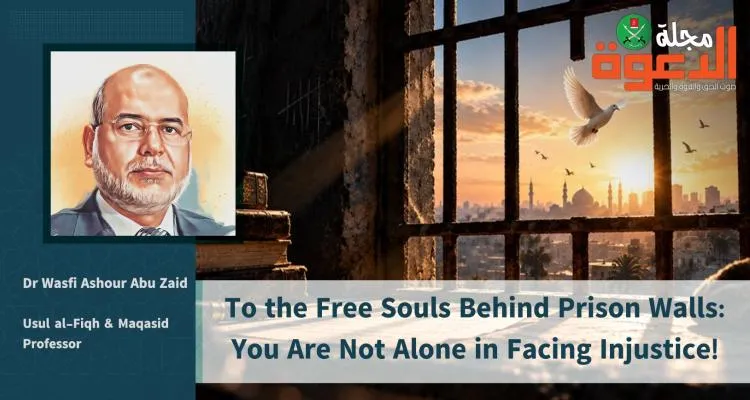
To the Free Souls Behind Prison Walls: You Are Not Alone in Facing Injustice!
Dr Wasfi Ashour Abu Zeid
Praise be to God, who has forbidden injustice unto Himself and prohibited it among His servants, who has commanded justice and benevolence, and made the defense of the oppressed an essential requirement of faith. May peace and blessings be upon our master, the Messenger of God—he who established the scales of truth, upheld human dignity, and warned against injustice and its consequences in this world and the Hereafter. Peace also be upon his family, his companions, and all those who follow his path in championing the truth and aiding the distressed.
To you, the noble ones of Egypt—beyond the prison walls:
To you, the free souls languishing behind the walls of Egyptian prisons—you whose bodies have been torn from your families and loved ones, yet whose cause has never faded from the collective conscience, nor have your rights been lost in the scales of justice. To you, for whom the nights have grown long and the years have rolled by as you await a dawn when freedom returns to its rightful owners, when children return to their parents, when scholars return to their sanctuaries of knowledge, and when reformers return to their fields of reform—we write.
We do not write merely to offer consolation in words that fade once the article ends; rather, we write to declare a stance—a conviction we hold as a religious duty to draw closer to God, a sacred trust upon our shoulders, and a pledge that time itself cannot break: We stand with you. We shall never contribute to your being forgotten; we shall never remain silent in demanding your rights; and we shall never grow so accustomed to injustice that it becomes an accepted norm! Behind those walls are some of Egypt’s finest sons: scholars, preachers, intellectuals, university professors, physicians, engineers, and economists—as well as figures from the realms of politics, administration, humanitarian aid, social work, and athletics. Among them are former ministers and individuals who once held high-ranking parliamentary positions. These men were productive minds, sources of valuable expertise, and reservoirs of energy that the nation ought to have harnessed rather than consigning them to oblivion. It is a profound loss for any nation when the talents of its own people are sidelined and their lives are drained away behind prison walls. Yet the gravity of injustice does not derive its weight from the status of the victim, but from their inherent human dignity; an unknown individual—whose name may be unknown to the public—possesses the same right to freedom and fairness as the most renowned scholar or the highest-ranking official.
Supporting you is a religious duty we owe to God.
Dear brothers, our standing with you is not a partisan alignment dictated by political ties; rather, it is a requirement of a faith that teaches us that justice is indivisible and that injustice does not become permissible simply because it is inflicted upon those with whom we disagree. God Almighty says: " Indeed, Allah commands justice, grace" [An-Nahl: 90]. He also says: " Do not let the hatred of a people lead you to injustice. Be just! That is closer to righteousness" [Al-Ma'idah: 8]. If justice is mandatory even toward those we detest, how, then, could it ever be acceptable to abandon it when it concerns our own compatriots and brothers?
The Prophet (peace and blessings of Allah be upon him) said: "Help your brother, whether he is an oppressor or is being oppressed." When asked how to help an oppressor, he replied: "By restraining him—or preventing him—from committing injustice; that is how you help him" [narrated by Al-Bukhari]. This principle establishes that aiding the oppressed is a duty and that restraining an oppressor from injustice is, in fact, a form of help to him. It also ensures that authority cannot serve as a shield against accountability. Thus, our opposition is not directed at a homeland we love, but at injustice—whoever the perpetrator may be—and we demand justice, regardless of who is called upon to uphold it. It is precisely because we love Egypt that we wish for it to be a nation where human dignity is never violated and rights are never lost.
In a *Hadith Qudsi* Allah says: "O My servants, I have forbidden injustice for Myself, and I have made it forbidden among you; so do not commit injustice against one another" [narrated by Muslim]. What greater abandonment could there be than to see one’s brother stripped of his rights, only to seek excuses—merely to soothe one’s own conscience and evade the duty to help?
Your strike is a cry that conscience must hear.
We have been following reports of the protest movement and hunger strikes within Egyptian prisons—actions taken in objection to detention conditions, the excessive duration of imprisonment, and the accounts of abuses and the denial of rights shared by those detained. These demands and grievances warrant an independent investigation and an urgent response. The fact that a person is driven to endanger their own health simply to be heard should stir the conscience—before a catastrophe occurs that cannot be undone.
While we understand the motives behind your protest and support your right to seek redress, we must emphasise that your lives are precious; indeed, the preservation of life is one of the paramount objectives of *Sharia* (Islamic law). We do not wish the pursuit of freedom to result in the loss of life. Rather, we call for a fair approach—one that safeguards lives and rights, ensures access to medical care, and guarantees humane treatment. The state’s duty is to address the root causes of suffering, not to punish those who voice their grievances.
It is profoundly painful for families to live in uncertainty about the fate of their forcibly disappeared loved ones; for detainees to languish for years without a fair judicial resolution; or for individuals to remain imprisoned long after their legal terms have expired. Such injustices—wherever they are proven to exist—cannot be justified in the name of security and stability. True security is founded on justice, and stability upheld by the protection of rights is far more enduring than stability built on fear.
To those in positions of power: beware the plea of the oppressed.
We address all those who have the authority to redress the injustices faced by these detainees: fear God regarding the fathers exhausted by waiting, the mothers worn down by weeping, the wives shouldering life's burdens, and the children growing up without their fathers. Remember that positions of power are transient, while the weight of responsibility remains; history keeps a record, and nothing is hidden from God. As the Messenger of God (peace be upon him) said: "Beware the plea of the oppressed, for there is no barrier between it and God." [Agreed upon].
Releasing those detained without legal justification, disclosing the fate of the forcibly disappeared, ensuring fair trials for those facing charges, and restoring rights to their rightful owners—these are essential duties. Fulfilling them preserves the dignity of the people and upholds the respect due to the state. We envision an Egypt that is a homeland for all its people—a place where freedoms are safeguarded and disputes are resolved through justice, the rule of law, and dialogue. We seek the realisation of fair retribution against those proven to have committed murder, and the holding to account—before an independent judiciary—of those responsible for the shedding of innocent blood, as well as for acts of torture, enforced disappearance, and other grave violations. There must be no impunity and no acts of vengeance outside the authority of the law. As the Almighty says: " There is ˹security of˺ life for you in ˹the law of˺ retaliation, O people of reason!" [Al-Baqarah: 179].
We stand with you—a pledge of active support, not mere words of consolation.
Dear friends, we do not claim to fully share your pain, nor can we compensate your children for the warmth of your presence. However, we can ensure that your cause is not consigned to oblivion and that the relentless flow of news does not dull our sense of responsibility. For the greatest danger to the human conscience is becoming so accustomed to tragedy that one loses the capacity to be moved by it.
We stand with you—through our words that reject injustice, our unceasing prayers, our firm stance in demanding your rights, and every legitimate effort to secure justice for you. We stand with your families, who bear the heavy burden of your absence; with your children, who long for the day you return; and with every oppressed person in Egypt’s prisons—whether known or unknown, and regardless of whether we agree with them. Our guiding principles are a commitment to truth, justice, and human dignity.
We are not required to echo the views of an oppressed person to support them; rather, we must simply refuse to accept any injustice inflicted upon them—just as we would for ourselves. The Prophet (peace and blessings of Allah be upon him) said: "A Muslim is the brother of another Muslim; he does not wrong him, nor does he abandon him [to those who would wrong him]" [Agreed upon]. This means one should neither leave a person exposed to those who might oppress them, nor forsake them when they are in need of support. What kind of brotherhood remains if we choose the comfort of silence, leaving the oppressed to stand alone? A brotherhood that does not manifest in times of hardship is one whose sincerity must be questioned. Speaking the truth in defence of the oppressed is a trust—a duty that one must fulfil before Allah.
Hope will always rise above the walls.
Dear loved ones, while we cannot determine when relief will come, we pray that this movement marks the beginning of a breakthrough—that it may awaken consciences and open the doors to justice. No matter how long oppression persists, it never gains legitimacy through its longevity, and rights are never forfeited simply because they are forgotten. The Almighty says: " Do not think ˹O Prophet˺ that Allah is unaware of what the wrongdoers do" [Ibrahim: 42]. He also says: " So, surely with hardship comes ease. Surely with ˹that˺ hardship comes ˹more˺ ease" [Ash-Sharh: 5-6]. Placing one’s trust in Allah does not mean surrendering to falsehood; patience does not mean accepting aggression; and hoping for relief does not negate the need to take practical steps to achieve it.
Protect your lives and your dignity, and never despair of Allah’s mercy. We pray that He—glory be to Him—strengthens your hearts, heals your sick, returns the disappeared to their families, reunites grieving households, grants justice to those unjustly killed and their loved ones, and opens the doors of justice, freedom, and mercy for Egypt. To you, the free people of Egypt behind prison walls, we renew our pledge: physical distance shall never stand in the way of our duty to support you; the passage of time shall never be an excuse for us to forget; and we will never accept that prison cells become graves for the living. You are not alone, and your rights have not been forgotten. The justice we demand for you is the same justice we seek for all of Egypt—until the day arrives when the doors are thrown open, families are reunited, the oppressed find redress, those proven guilty of murder are held to account, and the wounds of a nation—a nation whose children all deserve to live in freedom, dignity, and security—are finally healed.