


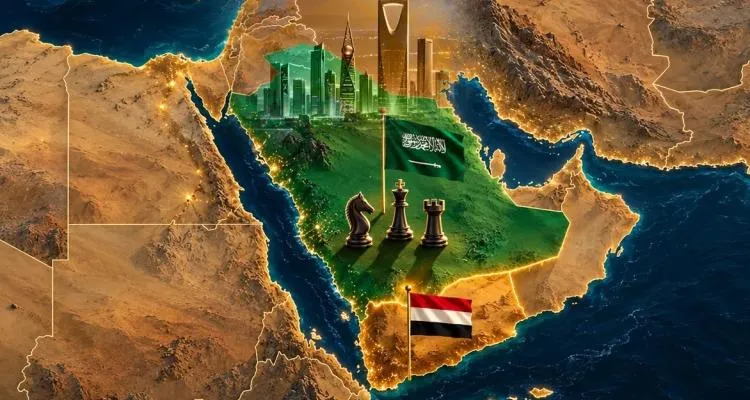
Saudi Arabia’s Missteps in Yemen and the Limits of Relying on Allies
Dr. Khalil Al-Anani, a professor of political science, hosted an extensive and insightful discussion on his YouTube podcast, "Ilm Nafi’", featuring Dr. Essam Abdel-Shafi, a professor of political science and international relations. The conversation explored Saudi policy in Yemen, Gulf security, and the future of relations among regional states. In *Al-Da’wah* magazine, we present this summary to highlight the core ideas discussed and to facilitate further dialogue, while noting that the views and assessments expressed remain those of the guest. The significance of this discussion lies in its dual focus: reviewing past policies and seeking potential exits from the current crisis—though some of the guest’s judgments and accounts of events remain open to debate and require independent verification.
Dr. Essam Abdel-Shafi offers a critical perspective on Saudi policy. In his view, much of the predicament facing the Kingdom stems from its choices in Yemen, its approach to managing alliances, and its heavy reliance on American protection. He argues that overcoming this impasse requires a comprehensive review—one that begins internally and extends to the Kingdom’s relationships with Yemen, Iran, and other neighbouring states.
Yemen at the Heart of the Regional Crisis
Abdel-Shafi places the war in Yemen within a broader context than the conflict between Saudi Arabia and the Houthis. He contends that the region is currently in a phase of attrition—one that strains national economies, security capabilities, and political cohesion, and could ultimately threaten the very unity of these states. For this reason, he cautions against viewing the confrontation with Iran solely as an opportunity to weaken a regional adversary. Arab states might end up paying a far higher price than they anticipate, without ever achieving the goal they are banking on.
The author questions the assumption—found in some calculations—that the Iranian regime could be toppled with ease. He attributes this to the presence of institutions in Iran capable of replacing leaders and ensuring continuity, in contrast to many Arab regimes, where decision-making is heavily tied to the individual ruler. Hence his warning: Arab regimes might well become destabilised before the Iranian regime itself falls.
Despite his pessimistic outlook, he does not rule out a change of course; he leaves room for sudden shifts that could reshape the landscape. However, he finds nothing in the policies discussed during the conversation to offer reassurance about the direction of events.
The Roots of Saudi Policy in Yemen
The guest looks back to the 1960s, when Yemen entered a prolonged period of internal conflict and foreign intervention. He highlights the confrontation between Saudi support for the Royalists and Egyptian intervention in favour of the Republicans—a struggle led by Gamal Abdel Nasser. In this view, both countries played out part of their regional rivalry on Yemeni soil, while the Yemeni people bore the costs.
He then traces the historical divide between the North and the South—linked to the power dynamics of the Cold War—leading up to unification, the rule of Ali Abdullah Saleh, and the 2011 revolution. In analysing these phases, he emphasises that Saudi Arabia relied more on individual rulers, tribes, and established power brokers than on fostering the development of a stable Yemeni state.
He argues that Riyadh sought to maintain its influence in Yemen by playing various factions against one another. While this policy granted Saudi Arabia leverage, he contends that it also weakened state institutions and left the country perpetually vulnerable to instability. From this perspective, the Gulf Initiative—which followed the 2011 revolution—is viewed as a mechanism that contained popular change and redistributed power, while failing to address the underlying issues that drove Yemenis to revolt in the first place.
How did the Houthis become the dominant force?
Abdel-Shafi offers a key explanation for the rise of the Houthis: he argues that prioritising confrontation with the Muslim Brotherhood and the Islah Party skewed Saudi Arabia’s strategic calculations. He contends that, in the post-revolution period, Riyadh helped empower the Houthis—viewing them as a "lesser evil" to be leveraged to weaken a "greater adversary," with the intention of dealing with the Houthis later.
However, according to his analysis, the force that was thought to be containable instead expanded, while the factions targeted by these Saudi calculations declined. Consequently, the Houthis gained the upper hand in shaping the reality on the ground, eventually becoming a direct threat to Saudi Arabia.
He points to the alliance between Ali Abdullah Saleh and the Houthis—formed after years of war between them—to illustrate the volatility of Yemeni alliances. Saleh, once a partner of Riyadh, entered into an alliance that enabled the Houthis and their allies to take over Sanaa in 2014; the conflict between the two sides ultimately ended with Saleh’s death.
In this light, the guest links the 2015 Saudi-led military intervention to a series of prior decisions. In his view, the war was an attempt to address the consequences of policies Riyadh itself had helped shape—policies that became increasingly complex as the fighting persisted.
What could the funds spent on the war have achieved? The discussion touches on the war's excessive cost, though it does not provide a detailed breakdown of the figures. Citing substantial estimates of expenditure and losses, Abdel Shafi raises a question: what might have been achieved had even a portion of these resources been directed towards the reconstruction and development of Yemen?
He argues that investing in infrastructure, public services, and job creation could have fostered a different relationship between the two nations—one that might have earned Saudi Arabia broader acceptance within Yemeni society. Stable relations require shared interests that people can tangibly feel in their daily lives; relying solely on ties with rulers and tribal leaders is insufficient.
He emphasises Yemen’s significant human and social capital, as well as the deep-rooted connections it shares with Saudi Arabia and the Gulf states. In his view, factors such as geographical proximity, intermarriage, tribal kinship, and labour ties form a solid foundation for a long-term partnership.
He contends that squandering these bonds in favour of conflict has deprived both sides of vast opportunities, with resources that could have bolstered stability instead consumed by a war that has failed to produce a viable settlement.
Does Saudi Arabia Fear a Stronger Yemen?
The interviewer discusses the common assertion that Saudi Arabia does not want a strong Yemen on its borders. Abdel Shafi responds by distinguishing between the state’s interests and the ruling regime’s calculations. While the regime might view the rise of a powerful neighbour with suspicion, this does not mean that weakening that neighbour serves the country’s security.
He argues that a stable Yemen—linked to Saudi Arabia through clear interests and mutual understandings—could contribute to the Kingdom’s security. Conversely, a fractured Yemen becomes a breeding ground for armed groups, competing power centres, and foreign interference, with the repercussions of its instability inevitably reaching the Saudi border.
He draws a parallel to Egypt’s exposure to developments in Sudan and Libya; a major state cannot insulate itself from the collapse of its immediate neighbourhood. For this reason, he advocates re-evaluating the notion that Saudi security depends on a weak Yemen, proposing instead a policy aimed at fostering a stable neighbour—one with whom the Kingdom can reach understandings and hold accountable for its commitments.
He cites his meetings with Yemenis who express a desire for broader rapprochement with the Kingdom, suggesting that this indicates social readiness that could be built upon—though he acknowledges that such encounters alone are insufficient to gauge the sentiments of Yemeni society as a whole.
Iran and the Vacuum Created by State Fragility
The guest does not deny that Iran has an agenda and influence in Yemen, but he rejects the idea that the crisis should be explained solely through the lens of Iranian intervention. He raises questions about the conditions that enabled such interference and about the responsibility for policies that weakened the state, thereby allowing external powers to expand their presence.
He contends that the fragility of institutions and the absence of an inclusive national vision create a vacuum—one that any actor with the necessary organisation, resources, and allies can exploit. Accordingly, countering Iranian influence requires addressing the environment that allowed it to flourish, as well as dealing with its political and military instruments.
Furthermore, he rejects the notion that the Saudi-Iranian conflict can be reduced to a sectarian dispute. In his view, both states act to protect their interests, influence, and regime survival, while using sectarian identity as a mobilising tool. Consequently, he believes that negotiation is possible, provided there is a willingness to discuss interests and concerns—moving beyond a discourse of perpetual hostility.
The Problem of Decision-Making and the Reliance on Washington
Abdel Shafi attributes Saudi Arabia’s setbacks to a miscalculation of the balance of power, an overestimation of the outcomes of military action, and a failure to recognise the limits of its allies' commitments. He further points to the weakness of the institutions that ought to review decisions, assess their costs, and advocate corrective measures.
When power is concentrated and accountability is weak, errors are more likely to persist, even after their consequences become apparent. He argues that the absence of institutional review explains why the same flawed strategies are repeatedly pursued rather than reconsidered.
He offers a broad critique of Saudi Arabia’s relationship with the United States, suggesting that Saudi Arabia placed excessive faith in spending, arms deals, and political ties as guarantees of protection. He cites the 2019 attacks on oil facilities to illustrate the gap between what an ally expects and what Washington is prepared to do.
Moreover, he interprets Riyadh’s recent overtures towards China and Iran as steps that have not yet evolved into a firm strategic shift. In his view, diversifying international relations requires sustained political will, robust institutions, and indigenous capabilities—it cannot be achieved merely by holding summits or announcing agreements and investments. Alliances That Fail the Test
The guest distinguishes between a relationship with a ruling regime and one with a state and its society. He argues that Saudi Arabia has invested heavily in the former—tying its influence on the survival of specific individuals and political arrangements that are subject to change—rather than consistently building a broader foundation of shared interests.
He contrasts this with Iran, which he describes as investing for the long term in cohesive social and organisational forces, thereby giving it a presence that is difficult to uproot. This comparison highlights his focus on the sustainability of influence, though the discussion does not delve as deeply into the costs borne by societies as a result of this Iranian policy.
Within the Gulf region, he observes that border disputes, the crisis surrounding Qatar’s blockade, and competition for influence have eroded trust and limited the capacity of regional states for collective action. Proximity in geography and history does not automatically translate into an alliance; such a partnership requires clear settlements and mutual respect for the interests of all parties involved.
The Limits of Turkish and Pakistani Support
The discussion addresses what is known as the "Mecca Alliance for Joint Defense" and questions its potential to provide direct military support to Saudi Arabia. Abdel-Shafi expresses scepticism about this prospect, citing the divergent priorities of the parties involved and the lack of consensus on a clear definition of what constitutes a threat warranting military engagement.
In his view, Pakistan has no interest in opening a front against Iran—especially given its existing challenges with India and Afghanistan, alongside complex domestic issues, border concerns, and the situation regarding the Baloch people. Consequently, he suggests that Pakistan’s cooperation will likely remain limited to areas such as training, intelligence sharing, joint military exercises, and defence industry collaboration, rather than extending to involvement in an open-ended war. Similarly, Turkey’s relationship with Iran is shaped by economic interests, energy requirements, and security considerations—particularly regarding regional proximity and the "Kurdish issue." Consequently, it is highly unlikely that Ankara would engage in a large-scale confrontation on behalf of Riyadh.
The author warns against framing this cooperation in sectarian terms; presenting it as a "Sunni alliance" against Iran only deepens divisions and poses further internal and regional complications for the parties involved.
Egypt, the UAE, and the Calculus of Support
The author links Saudi Arabia’s outreach to Cairo to a need for political, defensive, and naval support, as well as to shared interests in the Red Sea and the Suez Canal. However, he does not expect financial aid and investment to translate into direct Egyptian participation in the war in Yemen.
He offers sharp criticism of the Egyptian regime and of the Saudi assumption that financial assistance guarantees a military commitment whenever the need arises. He also questions the efficacy of joint naval frameworks, arguing that their true value should be measured by the security they deliver.
Regarding the UAE, the author notes that its policies in Yemen have clashed with Saudi interests—specifically through its support for local factions and its pursuit of spheres of influence. Nevertheless, he does not rule out a return to cooperation between the two nations should Riyadh find it necessary to leverage Abu Dhabi’s channels and connections.
He cautions, however, that relying on the same figures and mechanisms—without first analysing the root causes of past failures—risks recreating the crisis, even if it provides only a temporary lull.
Normalization and the Conspiracy Theory
Abdel Shafi rejects the hypothesis that Iran, the Houthis, and Israel are colluding in a single scheme to push Saudi Arabia towards normalisation. He questions what benefit Tehran or the Houthis could gain from a closer Saudi-Israeli relationship, given the ongoing conflict between these parties.
He argues that the path towards Saudi-Israeli rapprochement has long been under consideration; therefore, explaining it does not require assuming a comprehensive agreement among adversaries. Nevertheless, he opposes this trajectory and expresses scepticism about Israel’s ability to provide independent protection to Saudi Arabia, noting that Israel itself remains reliant on American support.
Where to Begin the Way Forward?
Abdel Shafi advocates viewing Gulf security as a regional responsibility shared by all littoral states, including Iran and Iraq. While acknowledging that the Gulf states have legitimate concerns about Iranian policies, he maintains that these concerns should be addressed through negotiations to establish clear guarantees and arrangements.
He calls for an end to the war in Yemen—viewing the acceptance of reduced losses as a responsible decision—and for subsequent efforts to build a unified, stable Yemen that maintains a lasting partnership with Saudi Arabia. Furthermore, he proposes reforming the Gulf Cooperation Council (GCC) mechanisms, enhancing defence cooperation, localising military industries, and developing the technical expertise required to operate and maintain weaponry.
He argues that internal reform is a prerequisite for this strategic reassessment: expanding freedoms, releasing detainees, strengthening popular legitimacy, building a productive economy, establishing effective institutions, and fostering a professional media. In his view, a state rooted in a cohesive society has a greater capacity to make independent decisions, bear the consequences of those decisions, and negotiate with other actors from a position of greater strength.