The "Muslim Brotherhood" Scarecrow and Its Counterproductive Effect in Israeli and American Elections
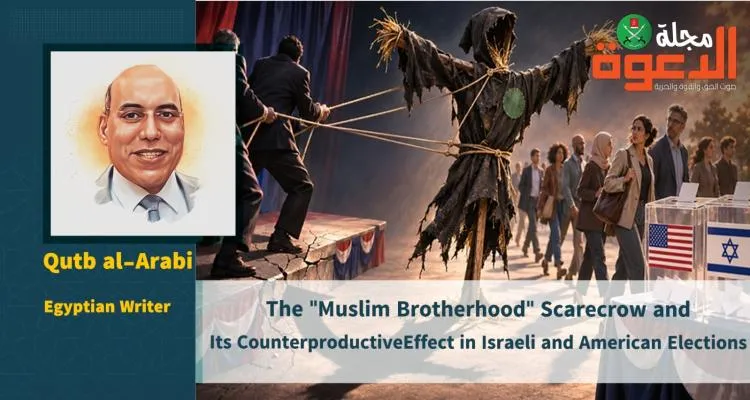
In a tense atmosphere as the polls closed on October 27, the Israeli Prime Minister stood holding a phone showing images of Arab voters crowding polling stations within the "Green Line"—where turnout reached 80%. He characterised these voters as supporters of the Muslim Brotherhood. Later, after they secured 19 seats—a result that shocked him and his supporters—he accused them of "stealing" the election. Similar accusations were echoed by his governing partners, Itamar Ben-Gvir and Bezalel Smotrich, who called for the arrest or investigation of Arab figures—allegedly linked to the Brotherhood—claiming they had funnelled money to influence the election.
In the United States, as the battle for the midterm congressional elections intensified, the "Muslim Brotherhood" issue also featured prominently. The campaign against Democratic candidate Abdul El-Sayed, who is of Egyptian descent, focused on his and his family’s past ties to the Brotherhood, as well as his support for the administration of President Mohamed Morsi—evidenced by a visit to Cairo, where he signed a statement of solidarity with Morsi’s policies. Former President Donald Trump himself joined these accusations, aiming to tarnish the image of "Abdul" in the eyes of American voters—particularly those on the right—by stoking fears that the United States would face a grave danger should Abdul El-Sayed, or other candidates of Islamic heritage, win.
Invoking the "Muslim Brotherhood bogeyman" in Israeli or American elections does not imply an acknowledgement of the group’s actual strength or its real influence on those contests. Both governments are well aware of the true status of the Brotherhood and similar entities; rather, they employ the name as a scare tactic to rally right-wing forces against their genuine political adversaries—whether they be Netanyahu’s rivals (who are themselves right-wing) or candidates from the Democratic Party in the United States.
Donald Trump paved the way for this scare tactic by issuing an executive order on November 24, 2025, designating the Muslim Brotherhood as a terrorist organisation. Europe is now attempting to follow suit; on October 8, 2026, the European Parliament issued a recommendation to develop a joint strategy to counter what it termed "Islamist infiltration" and the influence of the Muslim Brotherhood network. These initiatives in Washington and Brussels have been spearheaded by far-right factions that have gained momentum in recent years. A core priority for these groups has become opposing the presence and manifestations of Islam, framing them as a threat to European culture and social life. This has exposed the hollowness of European claims to respect for human rights: the Muslims targeted by these new policies are, in fact, European citizens—many of them second- or third-generation—who ought to enjoy the same full rights as their Catholic, Protestant, Jewish, and other fellow citizens.
Discussing the relationship between the Muslim Brotherhood and Israeli elections requires examining the origins of this involvement—specifically the "Arabs of '48," those who remained on their land after the establishment of the State of Israel. Whether by choice or compulsion, they became Israeli citizens, subject to the state’s laws—and, more egregiously, to its racist policies, despite their Israeli citizenship. Early on, a debate emerged among the Arabs of '48 about participation in Israeli elections and state institutions. This division became particularly pronounced within the Islamic Movement (an extension of the Muslim Brotherhood) from the mid-1990s. The central question was: Should they participate in the institutions of the Israeli state—including the Knesset and the government—to secure political and civil gains for Palestinians, or does such participation grant legitimacy to a state and its institutions that do not recognise Palestinian national rights?
The Northern Branch of the Islamic Movement, led by Sheikh Raed Salah, rejected participation in Knesset elections, viewing it as an endorsement of the legitimacy of the Israeli political system. It prioritised Palestinian national identity and an Islamic frame of reference, refusing political integration into state institutions. In 2015, the Israeli government banned the movement, citing security-related allegations and classifying it as a branch of the Muslim Brotherhood. Nevertheless, this faction has remained active through various civil society organisations and broader political and social initiatives.
The Southern Branch of the movement opted for political participation and engagement within Israeli institutions. Today, this faction is led by Mansour Abbas through the United Arab List, which secured seven seats in the most recent elections. This branch participated in the 2021 government led by Naftali Bennett and Yair Lapid, becoming the first Arab party with an Islamic foundation to join an Israeli governing coalition. In December 2025, this list formally separated—organisational structure-wise—from the Southern Islamic Movement and its Shura Council.
The success of the two "Arab-48" lists—the United Arab List, led by Abbas, and the Joint List, led by Ahmad Tibi—resulted in a strong parliamentary bloc of 19 deputies. This substantial number has disrupted the Israeli political landscape, as efforts to form a government have stalled due to the absence of a clear majority for any single bloc. Meanwhile, Benjamin Netanyahu and other figures on the far right—across both major political camps currently leading the results (those headed by Netanyahu and Gadi Eizenkot)—have voiced strong opposition to cooperating with these Arab lawmakers, with some even labelling them as affiliates of the Muslim Brotherhood.
In the United States, although the electoral battle was broad—encompassing all 435 seats in the House of Representatives and one-third of the Senate (35 seats)—the campaign of the Egyptian-American Muslim Democratic candidate, Abdul El-Sayed ("Abdul"), in Michigan drew the greatest share of controversy and attention. U.S. President Trump, his running mate J.D. Vance, and senior Trump aides intervened to oppose Abdul, seeking to alarm American voters by alleging that he was affiliated with the Muslim Brotherhood—a claim Abdul has repeatedly denied. Matters reached the point where Trump even warned against the Muslim Brotherhood gaining a foothold in Congress!
In both the Israeli and American contexts, the "Muslim Brotherhood bogeyman" was deployed to help right-wing factions win elections and prevent their opponents from succeeding. Yet the outcome was the exact opposite—the strategy backfired. The use of this scare tactic shifted public opinion: Abdul El-Sayed became the first Muslim to win a seat in the Senate, joined by several other Muslims who secured seats in the House of Representatives. In Israel, meanwhile, Arab candidates won 19 seats—a historic high in the annals of Israeli elections—including individuals whom Netanyahu and the Israeli right had accused of being affiliated with the Muslim Brotherhood. Thus, if one were to accept the right wing’s own accusations as true, it would mean that members of the Muslim Brotherhood have entered both the Knesset and the U.S. Congress—a direct consequence of the counterproductive impact of that very scare tactic.