
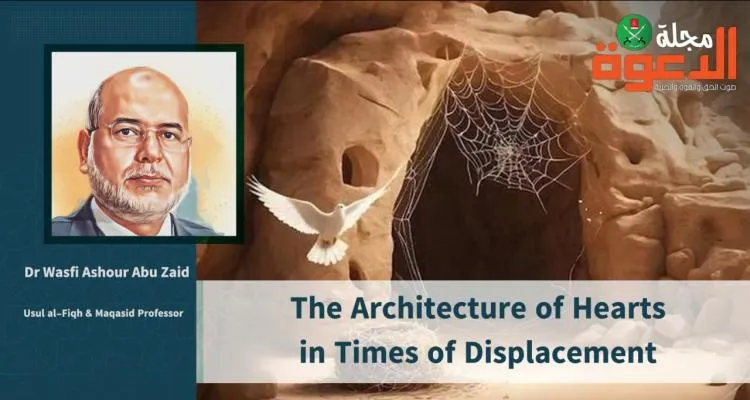
The Architecture of Hearts in Times of Displacement
Towards Utilizing "the Companionship of the Cave" in Migration to Contemporary Reality
Dr Wasfi Ashour Abu Zaid
The contemporary history of the Muslim Ummah is witnessing one of its most painful chapters. Exile and migration have become common denominators, uniting millions of Muslims whose homelands, despite their vastness, have become too confining. Refuge or alienation is no longer a mere occurrence in an individual's life but a widespread phenomenon that permeates the lives of entire peoples. This is a consequence of the dominance of injustice, the spread of tyranny, and the onslaught of trials that have made the choice to flee with one's life, faith, and freedom a compelling necessity, not a luxury.
When we examine the map of the Muslim diaspora today, we see a tragedy with multifaceted dimensions:
• The blessed land of Palestine: whose people have continued for decades to write epics of steadfastness and of systematic displacement. Millions have become refugees, scattered across the globe, carrying the keys to their homes and passing down from generation to generation the certainty of return and the purity of their cause.
• The Levant, the cradle of civilisation, Iraq: where unjust wars, oppressive tyranny, and foreign interventions have emptied the historical centers of Islam of their scholars and builders. Syrians and Iraqis now cross seas and oceans, facing the unknown in search of a safe haven to preserve their dignity and faith.
• Egypt, the land of the Nile, and Yemen, the land of wise faith: both have groaned under the weight of calamities and harsh political upheavals, forcing their finest youth, scholars, and thinkers into emigration, living in forced exile far from their spiritual and religious centers.
• Wounded Lebanon and afflicted Libya: where internal strife and chronic conflicts have consumed everything, driving their people into exile and despair.
• Muslims in East Turkestan and Tajikistan, and other Muslim minorities and ethnic groups in Central Asia, face systematic attempts to erase their religious and linguistic identities, making their exodus from their homelands a flight for their faith, a most beautiful example of devotional migration.
This vast diaspora, with its diverse ethnicities and languages, now faces profound existential, religious, and moral challenges in their lands of forced exile. Exile is not merely a physical relocation; it is a seismic shift that shakes the very foundations of a Muslim's psyche and values. They are torn between the pressures of assimilation and integration into their new societies, the trauma of loss and longing, financial hardship, and feelings of abandonment and persecution.
Amidst these raging waves of trials and tribulations, the most crucial existential and missionary question arises: What protects these migrants from falling and regressing? What is the impregnable fortress that preserves their morals, conduct, and behavior so that they may be shining beacons and guiding lights in their adopted lands?
The religious and faith-based answer rests on one truth: the cultivation of hearts. For the heart is the king of the organs, and its soundness is the soundness of the body, life, and conduct, especially in times of forced migration. If the heart is cultivated with certainty and divine companionship, exile becomes a cradle of education and spiritual opening, and the diaspora becomes a vast space for spreading the light of the prophetic message.
The Cave and the Shadows of Divine Companionship: A Contemplative Reading of the Verses of Surah At-Tawbah
When crises intensify for Muslims, they have no refuge but divine revelation. They seek guidance from His verses and draw inspiration from His actions, finding solace, peace, and tranquility in His teachings. In the history of the Prophet's noble life, the Hijra (migration), specifically the "Cave Incident," stands out as the ultimate and most perfect example for every Muslim who was unjustly driven from their home for no other reason than declaring, "My Lord is God."
The Holy Quran records this momentous and sacred event in Surah At-Tawbah, in the context of admonishing those reluctant to participate in jihad, reminding them that God is self-sufficient and that victory and empowerment do not depend on numerical superiority, but on the strength of one's connection with God and the flourishing of faith in their hearts. Allah, the Blessed and Exalted, says: {It does not matter˺ if you ˹believers˺ do not support him, for Allah did in fact support him when the disbelievers drove him out ˹of Mecca˺ and he was only one of two. While they both were in the cave, he reassured his companion, “Do not worry; Allah is certainly with us.” So Allah sent down His serenity upon the Prophet, supported him with forces you ˹believers˺ did not see, and made the word of the disbelievers lowest, while the Word of Allah is supreme. And Allah is Almighty, All-Wise.} [At-Tawbah: 40]
Reflecting on this great verse reveals truths of faith and education that the scattered Muslim on earth today should be raised upon:
1. Physical Exclusion and Divine Victory
The verse begins by establishing a decisive doctrinal truth: “God has indeed granted him victory.” Notably, the verb is in the past tense to emphasize the certainty of the event, at a time when the Prophet (peace and blessings be upon him) was at his weakest physically; pursued, alone with his companion, taking refuge in a dark, rocky cave on Mount Thawr, with the feet of the polytheists poised at the very edge of the cave—so close that if one of them had looked down, he would have seen them. The Quran calls this state of complete deprivation of material means a victory, because true victory lies in the steadfastness of the heart, its being filled with certainty in God, and the soul's turning away from the means, after employing them, towards the One who causes all things, the Exalted.
2. The Eloquence of Companionship and Human Compassion
The Quran's description of the Prophet (peace and blessings be upon him) and his companion as "the second of two" (referring to the two companions in the Quran) carries a profound message of faith, highlighting the importance of righteous companionship and the unity of hearts in times of hardship. This is followed by the verse, imbued with mercy and a call to action: "When he said to his companion, 'Do not grieve'" (referring to the Prophet's saying). Abu Bakr's (may God be pleased with him) grief was not out of fear for himself or anxiety for his life, but out of compassion for the greater truth and fear that the message would be lost if harm befell its Prophet (peace and blessings be upon him). Herein lies the faith-based role of the leader and the caller to faith: to strengthen trembling hearts, not by offering false material promises, but by connecting them directly to the highest and only source of security: "Indeed, God is with us" (referring to the Prophet's saying).
3. Tranquility and the Hidden Forces
The presence of God brings tranquility: “Then God sent down His tranquility upon him.” Tranquility is a serene, dignified peace that bestows contentment on the heart in the face of adversity. I recall here Sheikh Muhammad Siddiq al-Minshawi’s recitation of this noble phrase: “Then God sent down His tranquility upon him,” where he pauses on the word “upon him” with a gentle elongation that evokes profound tranquility and complete comfort. Then comes the support with forces: “And He supported him with forces you did not see.” This is a clear indication that God Almighty possesses unseen powers and means beyond human comprehension or the material calculations of enemies.
In the Shadow of the Cave Incident: Interpretations and Analysis by the Commentators
The scholars and commentators of the Muslim community have competed to extract profound spiritual insights and guidance from the verse about the cave, regarding it a constant source of wisdom for believers in every time and place, should they be besieged or displaced.
Imam Ibn Kathir (d. 774 AH) says in his book, Tafsir al-Qur'an al-'Azim: "And His saying: {If you do not aid him, Allah has already aided him when those who disbelieved expelled him, the second of two, when they were in the cave, when he said to his companion, 'Do not grieve; indeed, Allah is with us'}: meaning: Aid His Messenger, for Allah is his supporter, helper, protector, and guardian, just as He undertook his aid {when those who disbelieved expelled him, the second of two [when they were in the cave]}, that is, in the year of the Hijra, when the polytheists plotted to kill him, imprison him, or exile him, so he left them." He fled with his friend and companion, Abu Bakr ibn Abi Quhafah, and sought refuge in the Cave of Thawr for three days until the pursuers who had set out after them returned. Then they proceeded towards Medina. Abu Bakr, may God be pleased with him, was anxious that someone might discover them and harm the Prophet, peace and blessings be upon him. So the Prophet, peace and blessings be upon him, reassured him and said, "O Abu Bakr, what do you think of two people when God is their third?"
In modern times, the martyred scholar Sayyid Qutb – may God have mercy on him – presented, in his book *In the Shade of the Qur'an*, a unique, faith-based, and da'wah-oriented analysis of this verse. It touches the very core of the heart and perfectly reflects the reality of the oppressed and the emigrants. He says in his commentary on this verse: "That was when the Quraysh were fed up with Muhammad, just as oppressive power is always fed up with the word of truth. They could neither repel it nor bear it. So they conspired against him and decided to get rid of him. God revealed their plot to him and inspired him to leave. So he left alone, except for his companion, Abu Bakr, without an army or equipment, while his enemies were numerous and their strength was evident compared to his. The context depicts the scene of the Prophet and his companion: 'When they were in the cave.' The people were pursuing them, and Abu Bakr – may God be pleased with him – was anxious – not for himself, but for his companion – that they might discover them and reach his beloved friend. He said to him: 'If one of them were to look down at his feet, he would see us beneath them.' His feet. And the Messenger - [PBUH] - upon whose heart God had bestowed His tranquility, calmed his fears and reassured his heart, said to him: “O Abu Bakr, what do you think of two people when God is their third?”
Sayyid Qutb continues his analysis of the dimensions of this statement and its impact on faith and the cultivation of hearts, saying: “Then what was the outcome, with all material power on one side, and the Messenger (peace be upon him) and his companion devoid of it? Victory came from God, with unseen forces. Defeat, humiliation, and disgrace befell the disbelievers: ‘And He made the word of those who disbelieved the lowest.’ And the word of God remained in its exalted position, victorious, strong, and effective: ‘And the word of God is the highest.’ It has been recited as ‘And the word of God’ in the accusative case. However, the nominative reading is stronger in meaning, as it conveys a sense of affirmation.”
The word of God is inherently and fundamentally supreme, unaffected by any specific event. God is Mighty and does not humiliate His allies; He is Wise and decrees victory in due course for those who deserve it. This is an example of God’s support for His Messenger and His word. And God is capable of restoring it through other people, not those who are hesitant and slow. This is a real-life example, if they need any proof after God’s statement!
Analysis of the Interpreters' Statements and Their Connection to the Idea:
When we examine these interpretations and explanations closely, we find that they support the core idea of this article in several keyways:
• First: Disconnecting Physical and Spiritual Security: The interpreters agree that tranquility and peace descended upon the Prophet while the cave was under physical siege. This teaches the migrant and the displaced person today that instability in living conditions, the loss of identity documents, and life in refugee camps or in exile in a foreign land do not necessarily entail the loss of psychological security. Security springs from within, from a heart connected to God, a heart that feels God's presence. For such a person, the grandeur of palaces and the confinement of shelters are equal.
• Second: The Comprehensiveness and Continuity of Divine Presence: The divine presence declared by the Prophet (peace and blessings be upon him) when he said, “Indeed, God is with us,” was not an event confined to his time or one that ended with his death; rather, it is a constant and enduring truth of faith, applicable at all times and in all places to all who follow his path, carry his message, and are compelled to leave their land as steadfast and patient warriors. It is a living continuation of the Prophetic life, which was entirely a series of migrations and journeys between caves, from the Cave of Hira, where the heart first received revelation and connected with the Lord of the heavens and the earth, to the Cave of Thawr, where the new community was established and the foundations of steadfast behaviour and morality were laid amidst the storms.
Third: Transforming hardship into a blessing for spreading the faith: It is clear from the words of the author of "In the Shade of the Qur'an" that hidden forces and divine support begin as soon as the heart is freed from human sorrow and fear and places its trust in its Lord. The migrants among the nation's sons today, when they grasp this understanding, will cease playing the role of the weeping victim and will become the conquering caller to Islam, realising that God, in His wisdom and decree, brought them forth as good seeds that will bear fruit of Islam, faith, and good morals in their new migrant communities.
Aspects of Investing in the "Cave Companionship" Model in the Lives of Muslims and Immigrants Today
Transforming the jurisprudence of "Cave Companionship" and the cultivation of hearts from their theoretical and interpretive frameworks into practical action programs and lived behaviors in the diaspora requires embodying this Prophetic model in several practical forms, combining the authenticity of faith, the purity of morals, and good conduct:
1. Faith-Based Transcendence over Material Values and Assimilation
The greatest battles waged by Syrian, Egyptian, or Turkestani immigrants in their host countries (whether in the East or the West) are the battles for identity. "Cave Companionship" grants the believer a firm immunity that prevents them from falling into and dissolving into the values of host societies if those values contradict their religion and beliefs.
• Practical Form: This transcendence is manifested in the immigrant's pride in the rituals of their religion, including establishing prayer, preserving women's modest dress, building Muslim families, and abstaining from financial and moral transgressions—not out of isolation or hostility, but out of a distinct faith that inspires respect and invites others to learn about this great religion. The heart of a Muslim, filled with devotion to his Lord, sees the land of migration as a grand mosque and a space for spreading the message of Islam, not a place of lust and moral decay.
2. Solidarity, Mutual Support, and Building "Communities of Brotherhood": In the cave, the highest expressions of brotherhood and spiritual unity were evident between the Prophet (peace and blessings be upon him) and Abu Bakr (may God be pleased with him). Muslims across the globe today urgently need to emulate this model to end their fragmentation and disunity.
• Practical Application: Immigrants of various nationalities (Palestinian, Yemeni, Tajik, Libyan, and others) should transcend their ethnic and linguistic differences to unite under the banner of "brotherhood." This is expressed through the establishment of Islamic centers, educational institutions, and charitable outreach organizations that guide newcomers, provide psychological and material support, prevent them from feeling lost, and constantly remind them: "Do not grieve; indeed, Allah is with us." Here, nurturing hearts extends from the individual to the community, creating a pure and cohesive society in the land of exile.
3. Patience, Rejecting Despair, and Productive Outreach
One of the most dangerous consequences of forced migration is succumbing to despair and feeling frustrated and let down by those near and far, which may lead some young people to behavioral or intellectual deviance.
• Practical Application: The jurisprudence of the cave instils in the migrant a firm conviction that the ultimate victory belongs to the righteous and that the word of God is always and forever supreme. This conviction motivates the Muslim to be a positive and productive member of society; he learns the language of his new country, excels in his studies and work, and presents an honorable image of the sincere, trustworthy, and devoted Muslim. He transforms the energy of sorrow and refuge into energy for building, giving, and positive influence, feeling that his Lord, who saved His Prophet and his companion from the siege of the cave, is capable of bringing this nation out of the bottle of weakness and disunity into the realm of empowerment and glory.
Spiritual Education and Deepening Hidden Acts of Worship
The cave was originally a place of seclusion, worship, and devotion. Therefore, the lands of exile and migration should be used to rebuild the special connection between the servant and his Lord, far from the distractions of the homeland and the concerns of custom.
• Practical Application: Reviving established Sunnah practices, performing night prayers, consistently seeking forgiveness, reflecting on the Glorious Quran, and observing voluntary fasts. These spiritual and devotional acts serve as the "fuel of faith" that nourishes the heart, providing it with the energy and resilience to face the hardships of exile, and safeguarding its actions from recklessness or despair when calamities and trials befall it.
Crossing from the Constriction of the Cave to the Horizon of Victory
The Prophet's migration (peace and blessings be upon him) was not merely a story to be recounted for remembrance and blessing, but rather a continuous way of life and a renewed roadmap for the Muslim community to follow in all its times of hardship and vulnerability. This vast and painful dispersal of millions of Muslims today, from the east to the west of the earth, is not the end but a harbinger of a new birth, provided that hearts are filled with the divine support proclaimed from the depths of the Cave of Thawr.
When the oppressed, displaced Muslim migrant truly understands that severing ties with earthly means marks the beginning of divine, unseen victory, and when he erases debilitating human sorrow from his vocabulary, replacing it with certainty, tranquility, and diligent work, and when he realises that God has sent him to this earth to bear witness to the truth and defend virtue, only then will these scattered multitudes transform from a historical burden into a partnership for spreading the faith and a major civilizational force.
The narrowness of the cave was the legitimate, faith-based gateway to the conquest of Mecca and the establishment of the global Islamic state that illuminated the East and the West. Today, the dispersal of Muslims in refugee camps, in exile, and in the capitals of the East and the West will be – by the permission of God Almighty and thanks to the building of hearts with certainty and companionship – the great gateway to spreading the light of this religion, demolishing the thrones of tyranny, and raising the word of God to be supreme in every region and valley. God Almighty has spoken the truth, as He says, followed by the clear and absolute promise: “Surely Allah is with those who shun evil and who do good deeds.” [An-Nahl: 128]
