


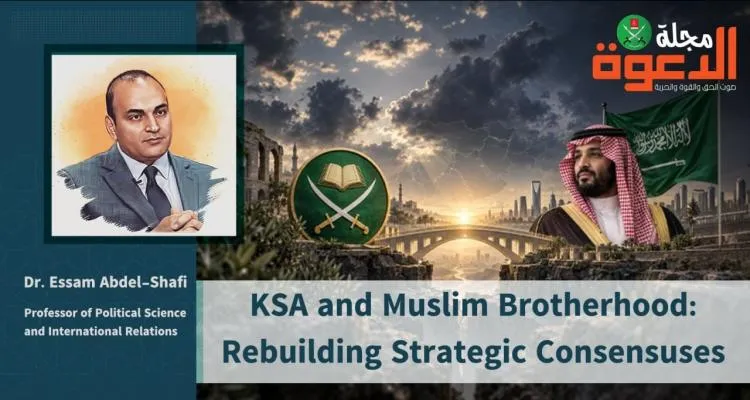
KSA and Muslim Brotherhood: Rebuilding Strategic Consensuses
Dr. Essam Abdel-Shafi
Professor of Political Science and International Relations
Roots of KSA-MB Relationship: From Foundation to Alliance:
In 1936, King Abdulaziz Al Saud, the founder of the Saudi state and its first king, and Imam Hassan al-Banna, the founder of the Muslim Brotherhood, met for the first time to lay the foundations of the relationship between the Saudi state and the MB. This relationship began on a "formal" footing, and the meeting constituted a recognition of the significance of each party to the other, at a historically critical juncture in the life of the Islamic world – particularly in the aftermath of the fall of the Ottoman Empire, the Zionist penetration of Palestinian lands, the British and French Mandate policies in Iraq and the Levant, and the world's movement toward a devastating second world war.
Following the 1952 coup, the fall of the monarchy, and the proclamation of the republic in Egypt, a phase of close alliance started between the two parties, in which each party found that the alliance served its own particular interest. The Brotherhood found in Saudi support an exit from the persecution of Nasser's regime, while Saudi Arabia found in the Brotherhood a powerful ally with which to confront the tide of Nasserist Arab nationalism – which it viewed as carrying the seeds of political and religious conflict with it. This rapprochement coincided, in its timing, with the nature of the struggle at the apex of the international order during the Cold War, between the East and the West, and between Saudi Arabia backed by the American West and Egypt backed by the Soviet East.
I shall, however, skip over all the historical stages of the relationship since 1936 – with their successes and setbacks – and pause at the present moment, in which the Arab and Islamic worlds, in the third decade of the twenty-first century, are passing through a phase of profound reshaping of sources of power, threats, and patterns of alliance. This phase was not born of the Al-Aqsa Flood carried out by Palestinian resistance movements against the Zionist entity on 7 October 2023, even though that was its principal catalyst; rather, it can be viewed within the framework of a broader context that started with the events of 11 September 2001 and the American war against the Islamic world, then the American invasion of Afghanistan in 2001, the American invasion of Iraq in 2003, the waves of the Arab Spring in 2011, and on to the Al-Aqsa Flood of 2023 and the American–Israeli assault on Iran in 2025–2026.
At the heart of all these transformations, Saudi Arabia – as a system and as a state – has been present, and the Muslim Brotherhood – as a movement and as an organization – has likewise been present, given that both are regarded as among the most important actors in the region's equations since the Brotherhood's founding in 1928, which preceded the establishment of the Kingdom in 1932.
Shifts in the Regional Environment and the Redefinition of the Relationship:
Within this extended vision of the first quarter of the twenty-first century, and the transformations and repercussions we have reached at in 2026, it can be said that the alliances, partnerships, and political and ideological agreements that governed regional relations during the preceding decades are no longer sufficient to explain the new interests or to build comprehensive strategic arrangements for the security and stability of Arab and Islamic states. Accordingly, addressing the relationship between Saudi Arabia and the Muslim Brotherhood through the binary of "enmity or reconciliation" may prevent a proper understanding of what the current phase demands, and of what it imposes on both parties in terms of the necessity of concensus – particularly when both face a regional environment in which cross-border threats are intensifying, files of political, social, and economic security are growing more complex, and the utility of relying on unilateral confrontational tools is diminishing.
On this basis, the proposition of re-engineering the partnership between the two parties is not a fanciful or unrealistic idea. On the contrary, given the current transformations, it compels everyone to redefine it in accordance with strategic interests – not only for the two parties themselves, but for all the peoples of the Arab and Islamic worlds, by virtue of the significance and standing that both parties enjoy in those worlds, regardless of all the challenges, crises, and systematic targeting that the Brotherhood has faced since the military coup in Egypt in July 2013.
National Security and the Reordering of Priorities:
Therefore, any framework for re-engineering these relations must proceed from the principle of reordering priorities: where security, stability, and shared interests become the primary entry point for the relationship, rather than invoking historical files as a definitive determinant of its possibilities. This requires transcending all the negatives of the first quarter of the twenty-first century in the course of this relationship – beginning with the statements of Saudi Interior Minister Nayef bin Abdulaziz about the Brotherhood in 2002 (made in the context of his interview with the Kuwaiti ‘Al-Siyasa’ Newspaper), and the Saudi designation of the Muslim Brotherhood as a terrorist organization in 2014, and Crown Prince Mohammed bin Salman's announcement of his intention to eradicate the Brotherhood in 2018, and even Saudi Arabia's welcoming of Trump's designation of the Brotherhood (as terrorist) in 2026.
The genuine challenges confronting the Kingdom have affected every dimension of its national security: the deteriorating situations in Yemen, Sudan, Iraq, and Somalia – all of which form circles of its national security – on the one hand; the escalating tension between Saudi Arabia and the UAE on the other; the tensions between Saudi Arabia and the Egyptian regime on a third front; the repercussions of the American–Israeli aggression against Iran and its implications for Saudi and Gulf national security on a fourth front; and the wars of hegemony, expansion, and genocide being waged by the Zionist entity in Palestine, Lebanon, and Syria – which will, at some stage, reach Saudi Arabia itself, on a fifth front. All of these are factors that push – indeed compel – Saudi Arabia to reconsider its truly serious strategic alliances, rather than merely its "media" and "fragile political" alignments that come as reactions to crises and conflicts rather than as a genuine reading of reality and its likely outcomes.
If the announcement of the signing of the Makkah Mutual Defense Agreement between Saudi Arabia, Pakistan, and Turkey on 7 August 2026 constitutes a symbolic step that requires concrete follow-up action, then the other critically important party that these three must think about in terms of re-engineering strategic relations with is the Muslim Brotherhood.
From a Trust Gap to Strategic Partnership:
If the accumulated trust gap between the two parties over past decades poses a challenge, the same gap has existed between Saudi Arabia and Turkey since the founding of the Kingdom, where the relationship between the two parties has witnessed numerous crises, challenges, and threats – yet this did not prevent the signing of the Makkah Agreement in 2026. The transition from conflict or rupture to the building of a strategic partnership therefore requires a gradual process of trust-building – especially since the foundation such building requires is already in place. I can say with personal conviction, based on numerous direct meetings with figures associated with the Muslim Brotherhood and on close monitoring of dozens of official statements issued by the organization over the last quarter century, that the Kingdom of Saudi Arabia holds a great standing and deep esteem within the Brotherhood. One of the clearest indicators of this standing was, for example, that the KSA was the first destination of the first visit made by late elected Egyptian President Dr. Mohamed Morsi, and his insistence on calling for the construction of a quadrilateral alliance comprising Egypt, Saudi Arabia, Turkey, and Iran to resolve the region's crises.
At the present stage, some view it impossible to announce a "Saudi–Brotherhood alliance" given the pressures the American variable imposes on regional actors, and while some point to "weakness and fragility in the Brotherhood's structure" (at present) and therefore argue that the relationship should start by redefining circles of shared interest and deepening dialogue on regional security, social stability, and how to confront expansionist projects in the region – and then develop gradually, according to a clear timeframe, before moving toward mutual accommodation whereby Saudi Arabia reassesses the Brotherhood and its role, and the Brotherhood redefines its relationship with KSA on the basis of respecting its sovereign choices and enhancing its security and interests – thereby creating positive accumulations that could, in the longer term, lay the ground for more stable arrangements.
The Urgency of Time and the Need to Build a Shared Lever:
However, I disagree with this approach and believe that neither party has the luxury of time to rebuild the partnership incrementally. While some say there is "weakness and fragility in the Brotherhood's structure," there is equally "weakness and fragility in the Kingdom's structure". The Brotherhood, through its presence, its popular base, and its capabilities, can constitute a popular incubator that serves as a strategic lever to address part of the weakness and fragility in the Kingdom's structure. Conversely, the Kingdom of Saudi Arabia, through its religious standing and strategic capabilities, can constitute a genuine lever to address part of the weakness and fragility in the Brotherhood's structure.
The present moment does not call for more outbidding and losing bets of the kind tried and proven to have failed over past decades – bets in which the Saudi system performed functional roles that ultimately came at the expense of the Kingdom's own national security, as evidenced by what it suffers today.
The Saudi–Brotherhood partnership must not be viewed in absolute terms as a matter of "political point-scoring" with one party or another, nor must it be viewed in absolute terms as a provocation of other regimes and governments. Rather, it must be viewed from the perspective that there are major risks threatening the Arab and Islamic worlds, and that in confronting these risks it is necessary to rebuild relations between the fundamental levers capable of addressing them – foremost among which are "Saudi Arabia as a state and as a standing" and "the Brotherhood as a movement and as an organization."
From Reconciliation to Rebuilding the Strategic Relationship:
For this reason, the principal question of this moment should not be: "How could Saudi Arabia and the Muslim Brotherhood move beyond their old disagreements?" but rather: "How could the changing nature of regional threats and shared interests be converted into a new framework for the relationship – one that renders historical disagreements manageable?"
The goal, therefore, is to move from a logic of reconciliation between the two parties to a logic of rebuilding a strategic relationship between two principal actors – one that can reshape the region at a time when it faces schemes targeting the security of its peoples, their resources, and their wealth.
Disclaimer: This opinion article reflects primarily the views of its author and does not necessarily represent the views of the journal or the Muslim Brotherhood.