On the International Day in Support of Victims of Torture... With Pain and Hope
Every year on the twenty-sixth of June, the world stands before one of the ugliest crimes known to human history: the crime of torture. Despite the conventions signed, the slogans raised, and the bodies and organizations established, thousands of innocent people around the world still taste the bitterness of torture in prisons, detention centres, and conflict zones — a stark contradiction between declared principles and the reality that humanity continues to witness.
The Dignity of Man in Islam:
God has honoured mankind, saying in His Book: “Indeed, we have dignified the children of Adam, carried them on land and sea, granted them good and lawful provisions, and privileged them far above many of Our creatures” [Al-Isrâʼ, 70]. Among the requirements of this honouring is that He forbade his torture, regardless of colour, race, or religion. Indeed, God's message to Pharaoh, conveyed through Moses and Aaron, peace be upon them both, was a message of liberation for man and a prohibition of his torment. God says: “So go to him and say, ‘Indeed, we are messengers of your Lord, so send with us the Children of Israel and do not torment them. We have come to you with a sign from your Lord. And peace will be upon him who follows the guidance.’” [Tā Hā, 47].
This legislative protection extended to cover every part of the human body. God says: “And We ordained for them therein a life for a life, and an eye for an eye, and a nose for a nose, and an ear for an ear, and a tooth for a tooth, and for wounds, retaliation.” [Al-Māʼidah, 45].
This protection further extended to honour and human dignity, as God, Glorified is He, says: “And those who harm believing men and believing women for [something] other than what they have earned have certainly born upon themselves a falsehood and manifest sin.” [Al-Ahzāb, 33:58]. And the Messenger of God, peace and blessings be upon him, said: “Indeed, God will torment those who torment people in this world” (related by Muslim).
Indeed, the mercy of Islam extended even to animals; it mandated kindness toward them and forbade their torment. The Messenger of God, peace and blessings be upon him, said: “A woman was tormented because of a cat she had confined until it died of hunger, and so she entered the Fire because of it” (agreed upon by al-Bukhārī and Muslim).
The Prohibition of Torture: Between Law and Reality
These principles were not confined to Islamic legislation alone; they have today become firmly established principles in international law, which regards torture as a crime that cannot be justified under any circumstance.
On the twenty-sixth of June each year falls the occasion of the International Day in Support of Victims of Torture, adopted by the United Nations in 1987. One hundred and seventy-four (174) states have acceded to its convention, making the prohibition of torture one of the most widely accepted and consensual principles of international law.
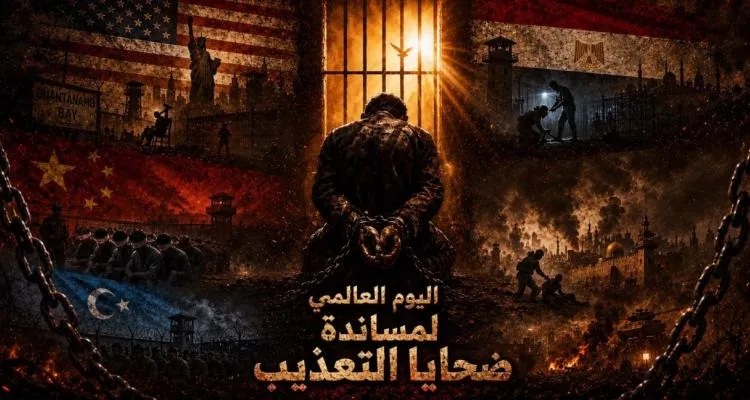
Yet practical reality remains rife with the disasters of torture and human rights violations committed by the powerful against the weak. Three major states have refused to sign the Optional Protocol to the Convention against Torture, which permits independent international visits to places of detention: the United States of America, China, and Russia. The danger of this lies in their ability to use the veto power in the Security Council to obstruct the condemnation of many crimes committed against humanity — quite apart from the structural flaw that the veto power itself represents, one that has often rendered the Security Council incapable of genuinely expressing the will of the international community.
At the same time, twenty Arab states have signed the Convention against Torture, yet only five of them have ratified the Optional Protocol permitting surprise visits to places of detention. Thus the convention, however lofty its aims and noble its purposes, has remained unable to impose its will upon the major powers, or upon states dependent on them that lack independent will and free political decision.
This is hardly surprising, for many of the gravest human rights violations in our contemporary world have been committed by the very great powers that raise the banner of defending those rights.
Examples of Contemporary Crimes of Torture
China: The Uyghurs as a Case Study
The Chinese authorities are committing grave violations against Uyghur Muslims, which reports issued by the United Nations and international human rights organizations have described as potentially amounting to crimes against humanity, while some states and parliaments have described them as genocide. China has established a vast network of detention camps aimed at erasing religious and cultural identity, restricting Islamic religious practice, destroying mosques, and subjecting the population to intensive electronic surveillance, in addition to pursuing resettlement policies designed to alter the region's demographic composition. It has likewise pursued a systematic policy that has led to the separation of thousands of children from their families and their placement in state institutions under the pretext of care.
The United States of America: Guantánamo and Abu Ghraib
The violations committed by the United States against detainees at the Guantánamo Bay detention camp remain vivid in memory since its establishment in 2002. At certain stages, the camp held some 800 detainees, gathered from nearly 45 countries, many of whom were transferred outside any legal framework. A report by the American Center for Constitutional Rights (CCR) reveals that approximately 86% of detainees were not captured on the battlefield, but were instead handed over in exchange for financial rewards that, in some cases, reached five thousand dollars per person suspected of belonging to al-Qaeda or the Taliban movement.
American forces, together with some allied forces and the Iraqi government forces of the time, applied the same methods of torture at Abu Ghraib prison. A number of detainees were sent to other countries under what became known as “secret rendition” programmes, where they were subjected to forms of torture far from any judicial or human rights oversight. The most horrific forms of physical and psychological torture, as well as sexual assault, were inflicted upon them. According to reports by Amnesty International and official American documents, a large proportion of detainees — ranging between 70% and 90% — were innocent or had never been proven guilty, having been arrested by mistake or on the basis of unreliable information.
The shocking violations connected to the Jeffrey Epstein case continue to reverberate around the world, given the vast network of exploitation and abuse they exposed, in which influential figures in politics, finance, and business were implicated. In February 2026, experts of the United Nations Human Rights Council issued a statement stating that the crimes documented in the “Epstein files” “exceed the legal threshold to be classified as crimes against humanity.” What makes the matter still more abhorrent is the involvement of a number of political, financial, and scientific elites in these violations — reflecting how influence and power can become a means of escaping accountability, before the facts are gradually exposed to public opinion.
The Israeli Occupation: Gaza and Palestine
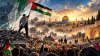
Regarding the crimes of the Israeli occupation in Palestine generally, and in Gaza in particular, we commend the position of the International Court of Justice, which called for provisional measures to protect civilians, to prevent acts that may fall within the framework of genocide, and to facilitate the entry of humanitarian aid. It likewise issued a landmark advisory opinion ruling the Israeli occupation of Palestinian territory unlawful.
Yet the Security Council has remained powerless in the face of the United States' repeated use of its veto power, which has prevented the issuance of resolutions obligating the occupation to a ceasefire, or holding Israel accountable for violating international law.
The world has witnessed an exceedingly dangerous precedent: prominent members of the United States Congress publicly threatening to impose financial sanctions and travel bans on judges of the International Criminal Court, its Prosecutor, and their family members, should arrest warrants be issued against Israeli officials.
Major powers have likewise threatened to cut off funding to international courts and organizations that adopt firm legal positions toward the occupation, and to impose sanctions on certain officials of the International Criminal Court, in an attempt to pressure it and to influence the independence of international justice.
Syria
In Syria, estimates indicate that no fewer than thirty thousand people were executed, died under torture, or starved to death inside prisons between 2011 and 2018. According to the Syrian Network for Human Rights, no fewer than ninety-five thousand people — among them thousands of children and women — were forcibly disappeared in the prisons of the Assad regime during the period from 2011 to 2022.
Egypt
In Egypt, the dispersal of the Rabaa al-Adawiya and al-Nahda sit-ins of opponents of the military coup took place before the eyes and ears of the world, its events broadcast live across the media. And yet, to this day, not a single official has been brought to trial over those events.
This was followed by the arrest of tens of thousands, many of whom were subjected to numerous forms of torture and ill-treatment, in addition to cases of death occurring within places of detention.
The United Nations Committee against Torture, in its concluding observations on Egypt issued in 2017, pointed to what it described as the systematic practice of torture, and expressed its concern at the authorities' insufficient cooperation with the Committee in addressing these violations.
Making matters still more horrific is the deliberate medical neglect within places of detention, which — according to independent human rights reports — has claimed the lives of approximately 1,300 political detainees.
These examples, however varied their locations and circumstances, confirm that the crime of torture is not bound to any particular religion, culture, or political system, but is rather the direct fruit of the absence of justice, the weakness of accountability, and double standards — when the powerful are placed above the law and the weak are left without protection or redress.
The Effects of Torture on the Individual and Society:
The impact of torture is not confined to the body whose organs are worn down or whose bones are broken; it extends to the psyche, the mind, the family, and society. The victim may carry the marks of torture for long years, remaining a captive of painful memories, and suffering psychological and physical effects that may never fade with the passage of time. Societies in which torture is widespread likewise pay a heavy price, manifested in the collapse of trust between citizen and state, the disintegration of social bonds, the spread of fear, silence, and despair, and the prevalence of a culture of impunity.
Nor does the harm of torture stop at the victim alone; its effects extend to his family and children, and to society as a whole, sowing the seeds of hatred, undermining trust in state institutions, feeding cycles of violence and revenge, and obstructing the building of a society founded on justice and the rule of law.
Everyone's Responsibility in Confronting Torture
Resisting torture is not the responsibility of governments alone; it is a moral and human duty shared by civil society institutions, human rights bodies, the media, intellectuals, jurists, scholars, and every person of living conscience. Silence over torture prolongs it, and turning a blind eye to it widens its scope, whereas exposing it, documenting its crimes, holding its perpetrators accountable, and standing by its victims — all of these represent necessary steps toward building a more just and humane society.
The responsibility of scholars and preachers is no less important than that of human rights advocates, for it falls upon them to instil the sanctity of life, to safeguard honour, to preserve human dignity, to implant the values of mercy and justice in souls, and to make clear that oppression and torture are among the gravest of crimes, for which God has promised their perpetrators punishment in this world and the next.
The Path to Salvation
We hold that the cornerstone of confronting this human disgrace begins with the revival of consciences, the upbringing of souls upon the values of true religion, and the constant remembrance of God's watchfulness, Who holds every soul accountable for what it has earned, so that no one is wronged in His sight, and no injustice is ever lost before Him. When hearts are filled with the fear of God, that fear becomes a wellspring of mercy toward creation, of restraining harm from them, of preserving their dignity, and of establishing justice among them.
If nations are to be measured by the extent of their respect for human dignity, then torture remains a witness to the collapse of values when power is severed from justice, politics from ethics, and law from conscience. It will forever remain the duty of free people everywhere to stand beside the wronged, and to reject torture, whoever its perpetrator, and whatever the identity of its victim; for human dignity is indivisible, and justice knows no double standards.
The message of Islam did not come merely to safeguard the human body; it came to safeguard man's humanity, his dignity, and his freedom, making mercy the foundation of relations among people, and justice the measure by which they are judged, as God, Glorified is He, says: “And We have not sent you, [O Muhammad], except as a mercy to the worlds.” [Al-Anbiyāʼ, 21:107].
Thus, the guidance of Islam converges with sound human conscience in rejecting torture and criminalizing every assault upon human dignity, whatever the victim's religion, sex, or colour.
We ask God to lift injustice from the oppressed, to free the captives, to heal the wounded, to have mercy upon the martyrs, and to grant humanity its right guidance, that justice may prevail, dignity be preserved, and every form of injustice and torture be lifted from mankind.
نص الرسالة كاملا: https://ikhwan.site/p-223460
Dr. Salah Abdel Haq
Acting General Guide of the Muslim Brotherhood
(Friday, 11 Muharram 1448 AH, 26 June 2026 AD)