

The July Coup (2013) – 13 Years On: When Injustice Leads to the Decline of Nations
All praise is due to Allah, Lord of the Worlds, Who said in Surat Hud: ﴾And your Lord would not have destroyed the cities unjustly while their people were reformers. ﴿ (Hud: 117); and peace and blessings be upon our Prophet Muhammad (PBUH) – the Seal of the Prophets and the Imam of the Messengers – and upon his kinship, his companions, and followers of his path until the Day of Judgment.
To proceed,
Allah Almighty has commanded implementation of justice and has ordained that injustice leads to the ruin of civilization and the destruction of nations, whereas reform brings about the resurgence of societies and the endurance of civilizations. These are the immutable laws of Allah that do not change or alter. We call these meanings to mind on the anniversary of the coup of July 2013, to draw lessons and reflect upon them – for nations that do not learn from their mistakes repeat them, and accordingly Allah's laws run their course upon them.
Three Great Losses
Thirteen years have passed since the ordeal of the coup. During them, the nation lost not only its elected civilian president and its nascent democratic experiment, but three of the greatest pillars of its renaissance, namely: its will, its leadership, and the finest of its human resources. When a nation loses the pillars of its renaissance, the effects of its calamity do not stop at the boundaries of politics; as they extend to the economy, to education, to the media, to the judiciary, to culture, and to morality, until decline and failure come to touch the lives of all its people.
First: The Loss of Will
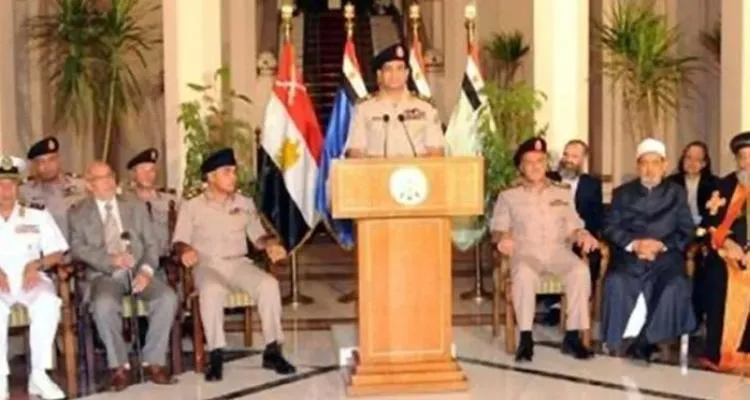
The greatest gift that the twenty-fifth of January revolution gave to Egyptians was the liberation of their will, and their belief in their capacity to shape their own future – after decades of despotism and subjugation. Immediately in the aftermath of the outbreak of revolution the Egyptian citizen started to feel, for the first time, that the will of the people is the source of legitimacy. Then came the military coup (early July 2013) and crushed this dream, returning the country by brute force to the fold of military rule, and confiscating the people's right to choose.
Perhaps, the most dangerous thing that can befall oppressed peoples is that their children ate to be raised to believe that might stands above right – that they should relinquish their rights out of fear of the tyrant's brutality. When that happens, conscience becomes corrupted, faith in the value of justice is weakened, despair replaces initiative, and the culture of submission prevails, which accordingly leads to the ruin of civilization.
Second: The Retreat of Taking the Lead
Throughout its history, Egypt has been known as the beating heart of the nation, a beacon of knowledge and thought, a state of great historical and civilizational weight, holding an exalted standing whose influence used to extend across the Arab and Islamic world. Yet the years of rule under the ill-omened July coup (2013) have taken their toll on this immense civilizational legacy, weakening Egypt's role, its leadership, and its international standing, and causing it to lose much of its regional presence. Through the coup, Egypt has lost what it had not lost in many of its modern wars.
Third: The Squandering of Human Capital
The most dangerous loss Egypt has sustained over these years was not money or property, but man himself. Thousands of competent individuals were disappeared into prisons; many scholars, preachers, thinkers, and experts were forced into exile, depriving the nation of their expertise and energies.
In fact, man is the true wealth of every nation and the foundation of every renaissance. So, the loss of minds and energies is among the gravest consequences of injustice: the loss of man – the builder of civilization – the weakening of his spirit of initiative, and the killing of belonging and hope in the hearts of the young people, all of this brings a nation nothing but decline and ruin. These are three of the most important pillars of renaissance that Egypt has lost under coup rule.
Five Cardinal Sins upon Which the Coup Was Built
Islam came to establish the life of people upon truth and justice, to safeguard their religion, their lives, their honor, their wealth, and their rights. Whenever these supreme necessities are violated, it is a harbinger of the ruin of civilization. The July regime has committed a series of grave transgressions incompatible with the flourishing of nations, beginning with the violation of a number of supreme values that paved the way for this deteriorating situation; where the most prominent of these are:
First: Falsifying the Will of the Nation
Islam established that false testimony is one of the gravest of sins, so much so that the Prophet, peace and blessings be upon him, said: "And I warn you against giving forged statement and a false testimony; I warn you against giving forged statement and a false testimony" – and the Messenger of Allah (PBUH) kept on repeating that warning till we (Prophet’s Companions) wished he would stop. (The Hadith is narrated by Imam al-Bukhari and Imam Muslim – agreed upon by both).
If false testimony extinguishes the right of an individual, then the falsification of the will of an entire people is far more dangerous, for it confiscates the nation's right to choose its rulers, overturns the scales of justice, and makes force the source of legitimacy in place of the popular will. When people lose trust in the value of their votes, they also lose trust in participation and reform, and frustration and apathy take hold.
Among the gravest effects of such falsification is that it raises generations to believe that right cannot be attained by legitimate means, and that force is capable of annulling the will of peoples – a message that is destructive to morality before it is destructive to political life.
Second: The Shedding of Blood
Allah Almighty says in Surat Al-Nisa: ﴾But whoever kills a believer intentionally - his recompense is Hell, wherein he will abide eternally, and Allah has become angry with him and has cursed him and has prepared for him a great punishment. ﴿ (Al-Nisa: 93)
Among the most painful things that have afflicted the conscience of the nation in those years are the scenes of bloodshed in the squares of the sit-ins (organized to protest against the removal of the elected president) – foremost among them the Rabaa Square – and the events that followed, in which hundreds of victims fell, without justice ever being achieved for the wronged or a deterrent established against the aggressors.
Blood does not become mere figures and numbers in the records of history with the passage of time; it does not pass beyond the justice of Allah, but it remains a pending right until Allah judges it on the Day when mankind stands before the Lord of the Worlds. In this regard, the Messenger of Allah, peace and blessings be upon him, said in Hadith: “A believer continues to guard his Faith (and thus hopes for Allah's Mercy) so long as he does not shed blood unjustly" – Reported by Ibn Umar (May Allah be pleased with them); and narrated by Imam Al-Bukhari.
The Prophet, peace and blessings be upon him, also warned against the supplication of the wronged, as when he (PBUH) sent Mu`adh to Yemen he said to him, "Beware of the curse of the oppressed as there is no screen between his invocation and Allah." – Reported by Ibn Abbas; narrated by both Imam Al-Bukhari and Imam Muslim.
The danger of this crime lies not only in the number of victims who fell, but in the fracture it causes in the collective conscience of society: people grow accustomed to witnessing injustice, they become familiar with scenes of bloodshed, and their condemnation of it weakens. When the sanctity of blood is disregarded, then all other sanctities will be disregarded as well.
Third: Fabricating Charges and Violating Dignity
Allah Almighty says in Surat Al-Nisa: ﴾But whoever earns an offense or a sin and then blames it on an innocent [person] has taken upon himself a slander and manifest sin. ﴿ (Al-Nisa: 112)
Among the gravest forms of injustice is when the charges become a tool to silence dissenters, when the innocent people are prosecuted and opinion leaders are imprisoned – not for any crime they committed, but for positions they adopted or words they uttered.
The effect of such injustice did not stop at the prisoner alone; it extended to his family, his children, and his parents, so that thousands of families lived years of loss, anxiety, and deprivation – effects that cannot be measured in numbers, but only by the wounds they leave in souls.
A society in which the innocent people fear justice and the unjust people are safe from accountability requires the revival of conscience before the amendment of laws, for true justice begins with man's fear of Allah before his fear of punishment.
Fourth: The Abandonment of Just Judgement by the Judiciary
Islam has highlighted the judiciary as a great trust. Allah Almighty says in Surat Al-Nahl: ﴾Indeed, Allah orders justice and good conduct and giving to relatives and forbids immorality and bad conduct and oppression. He admonishes you that perhaps you will be reminded. ﴿ (Al-Nahl: 90) And He also says in Surat Al-Maidah: ﴾O you who have believed, be persistently standing firm for Allah, witnesses in justice, and do not let the hatred of a people prevent you from being just. Be just; that is nearer to righteousness. And fear Allah; indeed, Allah is Acquainted with what you do. ﴿ (Al-Maidah: 8). And Prophet Muhammad, peace and blessings be upon him, warned against injustice, saying: “Beware of injustice. Injustice will appear as darkness on the Day of Rising…” – Narrated by Imam Muslim.
Justice in Islam is thus not a mere abstract moral slogan, but a religious obligation and a human value that safeguards rights, preserves dignity, and prevents despotism and transgression.
One of the hallmarks of the coup years was the transformation of the judiciary into an instrument of political exclusion and the clearing of the field for the authoritarian, through mass trials and harsh sentences issued by both ordinary and exceptional courts, which stirred widespread controversy inside Egypt and beyond.
In fact, justice is the last fortress of the wronged people. When people's trust in justice is shaken, their trust in the state as a whole is shaken, for states do not endure by force alone; they endure when people are assured that their rights are protected and that justice stands above all.
Fifth: Lying and Falsification of Awareness
The coup d’etat of June 2013 did not rely on brute force alone; it enlisted a massive media apparatus that made lying and deception its method, and the justification of injustice, the distortion of opponents, and the monopoly of truth its own mission – until many people could only hear a single voice (that of authority).
The Messenger of Allah, peace and blessings be upon him, said: “… Falsehood leads to transgression and transgression leads to the Hell-fire. A man continues to speak falsehood till he is recorded with Allah as a great liar." – This Hadith was reported by Ibn Masoud; narrated by Imam al-Bukhari and Imam Muslim.
Lying does not merely corrupt a passing piece of news; it corrupts awareness, kills trust, and renders people incapable of distinguishing truth from falsehood. When right and wrong become intermingled and access to truth is obstructed, public awareness is weakened, social division deepens, and society becomes less capable of correcting its errors. In fact, this is only part of what the coup has produced.
Where Have These Cardinal Sins Brought Us?
What is Egypt experiencing today, of economic crise, the mounting debt, the declining living standards, the emigration of skilled professionals, and the shrinking of freedoms are not isolated, unrelated events. They are the natural consequence of a course that began on the day when the will of the nation was suppressed, justice was squandered, and rights were violated.
Injustice does not corrupt politics alone; it also weakens the economy, kills the spirit of initiative and belonging, destroys trust between the ruler and the ruled, and sows despair in the hearts of the young people.
In fact, Allah's laws have taught us that nations do not rise under injustice, nor do they stabilize under oppression; rather they are built upon justice, the safeguarding of rights, and the respect of man. When all of that is absent, decline becomes a natural consequence, however up high the slogans are raised.
A Message to the People of Egypt
To our precious people in Egypt…
The past years have shown that injustice does not produce stability, that lies do not build a homeland, and that power, when severed from justice, becomes a burden upon those who wield it before it becomes a burden upon others. These years have likewise proven that homelands are not built by excluding their children, squandering talented individuals, or silencing their voices, but by building trust, spreading justice, and respecting the will of the people.
Hence, the duty of this moment is not to deepen division (in Egyptian society), nor to invoke the spirit of revenge, but to repair what has been fractured, to unite around truth, and to work for a future founded upon freedom, justice, the rule of law, and the preservation of human dignity.
Responsibility of Reformers
The responsibility of reformers does not end with exposing injustice, nor with recording and documenting grievances for history; it really begins with building the person who rejects injustice, does not participate in it, does not assist it, and does not remain silent about it.
True reform begins with the education of conscience, the planting of the value of justice, the exaltation of the sanctity of life, the preservation of human dignity, and the respect of the nation's will – until a generation emerges, believing that real strength lies not in the capacity for brutality and oppression, but in the capacity to establish truth; and that the homeland lives only through justice and can only rise through all its people.
For this reason, preachers, scholars, educators, and intellectuals today bear an immense responsibility for rectifying what the coup has corrupted, by working to build awareness, entrench values, protect generations from despair and hatred, and plant hope in a future built by those who are sincere, not by those who are arrogant.
For this very purpose, Allah has made incumbent upon this nation the duty of commanding what is right and forbidding what is wrong; and He Almighty has made it one of the greatest means of protecting society from corruption, saying in Surat Al-Imran: ﴾And let there be [arising] from you a nation inviting to [all that is] good, enjoining what is right and forbidding what is wrong, and those will be the successful. ﴿ (Al-Imran: 104)
Tidings of Hope
However long the night of injustice may last, the laws of Allah do not change; truth may be tested, but it does not die; falsehood may swell, but it does not endure. Allah Almighty says in Surat Ibrahim: ﴾And never think that Allah is unaware of what the wrongdoers do. He only delays them for a Day when eyes will stare [in horror]. ﴿ (Ibrahim: 42)
Therefore, the anniversary of the coup should be an occasion for deep reflection on its effects, and for the renewal of faith that justice is an obligation, freedom is a responsibility, dignity is a right, and that the building of homelands begins with the building of man; that resistance to injustice is not achieved through injustice, but through steadfastness in truth, patience, work, and the preparation of generations that carry the message of reform.
Perhaps the greatest lesson we ought to learn from the anniversary of the coup is to raise our children to know that homelands are not preserved by fear, but by justice; and that their future is not made by hatred, but by faith, knowledge, work, unity of ranks, and loyalty to the values of truth and freedom.
A believer will always be certain that Allah Almighty does not allow the right of the wronged to be lost, that He does not break His promise to the reformers, and that the ultimate outcome belongs to truth and its people, however long the road could be. Allah says in Surat Yusuf: ﴾…And Allah is predominant over His affair, but most of the people do not know. ﴿ (Yusuf: 21).
Allah is the Greatest, and praise be to Allah,
Dr. Salah Abdel Haq
Acting General Guide of the Muslim Brotherhood
(Sunday, 20 Muharram 1448 AH, 26 June 2026 AD)