
The Holy Quran and Methodology of Cultural Advancement in the Time of Distorted Values
Praise be to Allah; and blessings and peace be upon the Messenger of Allah, Prophet Mohamed (peace be upon him), all his kinsfolk, companions, and followers till the Day of Judgment.
Now to the topic:
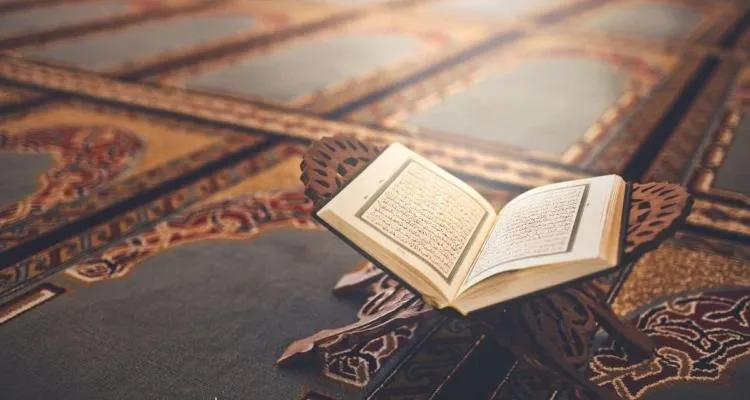
In a time when means are accelerating and material achievements are accumulating, while values are disrupted and morals are declining, there is urgent need to renew reconsideration of our relationship with the Holy Quran; not only as being a book of recitation and rituals, but also as being a methodology of guidance, building, and civilization.
The Quran was not revealed to be a text only preserved in hearts or recited in prayer niches, without having any effect on reality. Rather, Allah Almighty revealed the Quran to be a light for all people, and a balance through which life affairs are set upright.
Allah Almighty said in Surat Al-Baqarah: ﴾ The month of Ramadhan [is that] in which was revealed the Qur'an, a guidance for the people and clear proofs of guidance and criterion. ﴿ (Al-Baqarah: 185). And He also said in Surat Al-Nisa: ﴾O mankind, there has come to you a conclusive proof from your Lord, and We have sent down to you a clear light. ﴿ (Al-Nisa: 174)
Therefore, the Quranic discourse is a general human discourse that addresses the essence of man, his consciousness, his conscience, and his orientation in life, before addressing the details of his systems and institutions.
The martyr Imam Hassan Al Banna (may Allah have mercy on him) stated a painful truth when he said: "I have never seen a lost )book( more like a preserved one, nor a neglected (book) more like one that is cared for, than the Holy Quran in the reality of our nation today." As for many, the Holy Quran is only preserved in the hearts, honored in deluxe copies of its text, while it is inactive in their reality. However, the Holy Quran, in its reality, is a well-structured book, a comprehensive system, and a foundation for matters of religion and worldly affairs altogether. Allah Almighty said in Surat Fussilat: ﴾Falsehood cannot approach it from before it or from behind it; [it is] a revelation from a [Lord who is] Wise and Praiseworthy. ﴿ (Fussilat: 42).
Imam Al Banna summarized the nation's objectives regarding the Holy Quran in three matters: devotional recitation, legislative derivation, and practical application in the affairs of life. These are objectives which, if absent, they cause the balance to be disrupted, and if present, they cause the path to be straightened.
Al Banna’s student, Sheikh Mohamed Al-Ghazali (may Allah have mercy on him) expressed the same meaning when he pointed out that: The Quran should not be reduced to being merely a book from which we derive blessings and which we recite on occasions. Rather, it (the Quran) must return to being the leader of thought, the dominant source of knowledge, and the liberator of the mind from blind imitation and superstition.
Sheikh Yusuf Al-Qaradawi (may Allah have mercy on him) also mentioned the various forms of abandoning the Holy Quran, which are: abandoning contemplation, abandoning judgment, and abandoning action; not just abandoning recitation alone.
In fact, Sheikh Sayed Qutb (may Allah have mercy on him) summarized all these meanings by saying: “Life in the shade of the Qur’an is a blessing”; as he realized that the Quran is not merely a speech to be listened to, but a life to be lived, a consciousness to be shaped, and a status that elevates humanity to the horizon of divine honor.
The Quran was the (womb) from which ﴾…the best nation produced (as an example) for mankind…﴿ was born. It shaped the nation's perception of man as Allah's vicegerent on Earth; its perception of life as a trust; its understanding of the universe, Allah’s visible book; its perception of authority as a responsibility linked to achievement of justice.
The chapters and verses of the Quran crystallized the foundations of this nation and the commonalities of its unity with regard to the creed, as a basis, with regard to the Sharia, as a system, with regard to civilization, as an impact, with regard to the unity of the nation, as a bond, and with regard to the integration of the abode of Islam, as a comprehensive framework.
Therefore, the divine call came from heaven, stressing: ﴾So do not obey the disbelievers and strive against them with the Quran a great striving. ﴿ (Al-Furqan: 52) – striving by presenting argument and proof, building awareness, establishing evidence, and preserving the nation’s identity from dissolution.
In Islamic culture, the Qur'an was not merely a devotional text recited in prayer niches, but rather its founding mind and governing spirit. Based on the Quran, schools of knowledge, endowment systems, and judicial scales were established; and based on it also, worship was combined with construction, knowledge was linked with reverence, power with trustworthiness, and sovereignty with accountability. In fact, the Islamic renaissance was not a surplus of material, but rather the fruit of a supreme authority that shaped the conscience before regulating the law.
Conversely, the crises of our time and the decline of the value system (in the West) reveal that progress, if divorced from a higher moral framework, becomes fragile from within. Reducing civilization to material indicators (only) makes values agreements that can be redefined according to the balance of power, and the law becomes subservient to influence rather than a constraint on it.
Hence, the centrality of Sharia in the Quranic conception is evident; it is the balance that reconnects means with ends and regulates the movement of power with the standard of justice. Allah Almighty said in Surat Al-Jathiyah: ﴾Then We put you, [O Muhammad], on an ordained way concerning the matter [of religion]; so follow it and do not follow the inclinations of those who do not know. ﴿ (Al-Jathiyah:18)
Allah did not leave man in the darkness of confusion and the turmoil of desires but rather sent down a light to reveal the path to him. He, Almighty, said in Surat Al-Maidah: ﴾There has come to you from Allah a light and a clear Book. By which Allah guides those who pursue His pleasure to the ways of peace and brings them out from darknesses into the light, by His permission, and guides them to a straight path. ﴿ (Al-Maidah: 15-16)
The Quran is a book of explanation, where it reveals the truths; it is a book of healing, where it purifies hearts; and it is a book of mercy, where it overflows with tranquility. Furthermore, the guidance that reforms the individual, builds the nation, and through which civilization is established, is only achieved through the Quran.
O Muslims,
O all human beings,
This is the Book of Allah in your hands; its light never fades, its guidance never leads astray, and its mercy never ceases. Whoever turns to it with a sincere heart, it will bring him out of the narrowness of confusion into the vastness of certainty and bring him out of the darkness of bewilderment into the clarity of the path.
The Quran is not exclusive to one people over another, but rather it is an open invitation to every person who is exhausted by questions and weary of labyrinths.
Cultural revival begins here, that is, with the return of the Quran to a position of leadership: in thought, values, and order, not just in rituals. If minds are enlightened by the Quran, and hearts are humbled by it, and life is governed by it, then civilization will be upright, and man will regain his meaning.
The Quran does not compete with the world in its progress, nor does it rival it in its technology, but rather it provides it with a standard that protects it from deviation and gives it a compass to guide it in moments of turmoil.
If the Quran returns to its leading position in shaping awareness and building order, the relationship between man and himself, between man and his fellow man, between power and justice, and between freedom and responsibility – will all be rectified. Only then can civilization rise on a solid foundation, unshaken by storms and undisturbed by changing interests.
The Quran is not a past to be recalled, but rather a future to be built upon. The Quran is not a cultural choice either, but a condition for survival, a key to advancement, and a guarantee of salvation – as our Lord, may His glory be exalted, intended.
Allah is the greatest, and praise be to Allah,
And our final supplication will be, "Praise to Allah, Lord of the worlds!"
Dr. Salah Abdel Haq
Acting Muslim Brotherhood General Guide
(Monday, 12 Ramadan 1447 AH / 2 March 2026 AD)